
2024 Laboratory Division Annual Report
Table of Contents
Forensic Science Laboratory Services
Sedgwick County vs. Out-of-County Cases
Methamphetamine-Related Deaths
Drugs and Alcohol in Driving Cases
Drug-facilitated Sexual Assaults
Mission
The Sedgwick County Regional Forensic Science Center strives to provide the highest quality medicolegal and advanced Forensic Laboratory services to Sedgwick County and regional partners. Death Investigation and Forensic Autopsy services are conducted in a compassionate and objective manner to achieve accurate certification of cause and manner of death. The Forensic Laboratory services provide unbiased and accurate analytical testing to support the resolution of criminal cases. As an independent agency operating under the Division of Public Safety, the Forensic Science Center collaborates with public health and criminal justice stakeholders to reduce crime and prevent deaths.
Laboratory Leadership
Shelly Steadman, PhD / Director
Robert C. Hansen II, MSFS / Quality Assurance and Compliance Manager; LIMS Administrator
Tyson Baird, PhD, D-ABFT-FT / Chief Toxicologist
Kimberly Youso, MS, D-ABFT-FT / Toxicology Laboratory Manager
Lana Goodson, BA / Criminalistics Laboratory Manager
Sarah Geering, MS / Biology/DNA Laboratory Manager
Introduction
The Regional Forensic Science Center (RFSC) officially opened on December 21, 1995. The Center houses the Sedgwick County Office of the District Coroner (District Coroner) and the Forensic Science Laboratories. The Forensic Science Laboratories are made up of three major units: Criminalistics (Drug Identification, Firearms, and Fire Debris), Biology/DNA, and Toxicology (Antemortem and Postmortem).
The Forensic Science Laboratory is staffed with highly trained and experienced forensic scientists, many of whom have advanced scientific degrees (MS, MSFS, PhD). In 2024, the laboratory staff consisted of 22 scientists and 2 support personnel.
In April 1996, the Forensic Science Laboratory began accepting cases for firearms examinations. Three months later, the Biology Laboratory provided forensic examinations for the identification of biological fluids. The Toxicology Laboratory began producing comprehensive examinations in postmortem toxicology in support of the District Coroner in September of 1996. This was followed by the Forensic Science Laboratories providing forensic drug identification for local and regional law enforcement agencies. In November 1996, fire debris analysis was added to the Criminalistics Unit. In January 1997 the Biology/DNA Laboratory became the first short tandem repeat-deoxynucleic acid (STR-DNA) testing laboratory in the State of Kansas.
In 2003, the Forensic Science Laboratory first became accredited by the American Society of Crime Laboratory Directors/Laboratory Accreditation Board (ASCLD/LAB) under the ASCLD/LAB-Legacy program.
In February 2014, the Forensic Laboratory was granted ASCLD/LAB-International accreditation for Forensic Testing Laboratories in the categories of Controlled Substances, Quantitative Analysis, Antemortem Toxicology, Postmortem Toxicology, DNA-Nuclear, Body Fluid Identification, Fire Debris, Firearms, and Serial Number Restoration. The ASCLD/LAB-International accreditation program evaluates the laboratory’s management system, and technical procedures and practices against criteria set forth in ISO/IEC 17025:2005, and the testing laboratory requirements of the ASCLD/LAB-International Supplemental Requirements.
In 2018 and 2022, the Forensic Science Laboratory completed a full ANAB assessment under the ISO/IEC 17025:2017 and AR3125 standards. The laboratory was the first in the state and among the first in the nation to undergo assessment for these new international accreditation standards. This enhanced accreditation program is based upon the latest set of requirements against which a forensic testing laboratory can be evaluated.
Meeting these accreditation requirements demonstrates the Forensic Laboratory’s commitment to excellence in the services provided to submitting agencies.
Forensic Science Laboratory Services
Sedgwick County vs. Out-of-County Cases
The Regional Forensic Science Center functions as the primary forensic crime laboratory for all Sedgwick County law enforcement agencies and delivers forensic services to numerous additional counties and municipalities across Kansas. Most of laboratory casework supports Sedgwick County law enforcement agencies and the District Coroner, with a substantial portion of out-of-county analyses performed in conjunction with the District Coroner’s out-of-county autopsies. The municipalities and counties served in 2024 are listed in Table 1.
In 2024, the Forensic Science Laboratory provided expert testing services and consultations to 48 law enforcement agencies, fire departments, and district coroners from 13 Kansas Coroner Districts from across 20 counties. Out-of-county agencies that submit evidence for analysis are subject to a fee schedule set forth by the Sedgwick County Board of County Commissioners.
| Law Enforcement | Fire Department | District Coroner |
|---|---|---|
|
Bel Aire Police Department |
Arkansas City Fire Department |
Barber County |
|
Bentley Police Department |
Sedgwick County Fire Department |
Butler County |
|
Bureau of Alcohol, Tobacco, Firearms and Explosives |
Wellington Fire Department |
Cowley County |
|
Cheney Police Department |
Wichita Fire Department |
Edwards County |
|
Circle USD 375 Police Department |
|
Elk County |
|
Clearwater Police Department |
|
Ellis County |
|
Colwich Police Department |
|
Ellsworth County |
|
Department of Homeland Security |
|
Finney County |
|
Derby Police Department |
|
Ford County |
|
Goddard Police Department |
|
Greenwood County |
|
Goddard USD 265 Police Department |
|
Harper County |
|
Haysville Police Department |
|
Harvey County |
|
Kansas Highway Patrol |
|
Kingman County |
|
Kechi Police Department |
|
McPherson County |
|
Maize Police Department |
|
Pratt County |
|
Mulvane Police Department |
|
Reno County |
|
Park City Police Department |
|
Rush County |
|
Sedgwick County Courthouse Police Department |
|
Saline County |
|
Sedgwick County Sheriff’s Office |
|
Sedgwick County |
|
Sumner County Sheriff’s Office |
|
Sumner County |
|
Valley Center Police Department |
|
|
|
Wichita Police Department |
|
|
|
Wichita State University Police Department |
|
|
|
Winfield Correctional Facility |
|
|
Case Submissions
Law enforcement agencies submit criminal cases to the Forensic Laboratory for examination and analysis, and the District Coroner submits postmortem cases to assist in determining the cause and manner of death and for decedent identifications.
A case is established in connection with a criminal or death investigation and is assigned a unique case number at the time of initial submission. Each submission may contain multiple items of evidence associated with that case. For example, a homicide case submitted for Biology/DNA examination and/or analysis may include the victim’s and suspect’s clothing, a weapon, and blood swabs collected from the scene. As an investigation progresses, the submitting agency may provide additional evidence to the laboratory for testing. These are recorded as subsequent submissions and may include additional items for examination and/or analysis. To provide a more comprehensive measure of laboratory services provided, this report presents metrics for new cases submitted, cases submitted, submissions received, and items examined. New cases submitted refers to the number of new case numbers generated during the reporting period, while cases submitted refers to the number of unique case numbers for which evidence was submitted during the reporting period including any requiring supplemental examination and/or analysis. This approach is necessary because case complexity varies considerably; some cases involve a single submission containing one item, whereas others involve multiple submissions encompassing several items.
During the past several years, the laboratory has experienced increased submissions of sexual assault cases, cases involving emerging designer drugs, and polysubstance drug cases. These case types have also grown more complex to examine and analyze, often involving a greater number of associated items per case. In addition, firearms case submissions have increased compared with prior years.
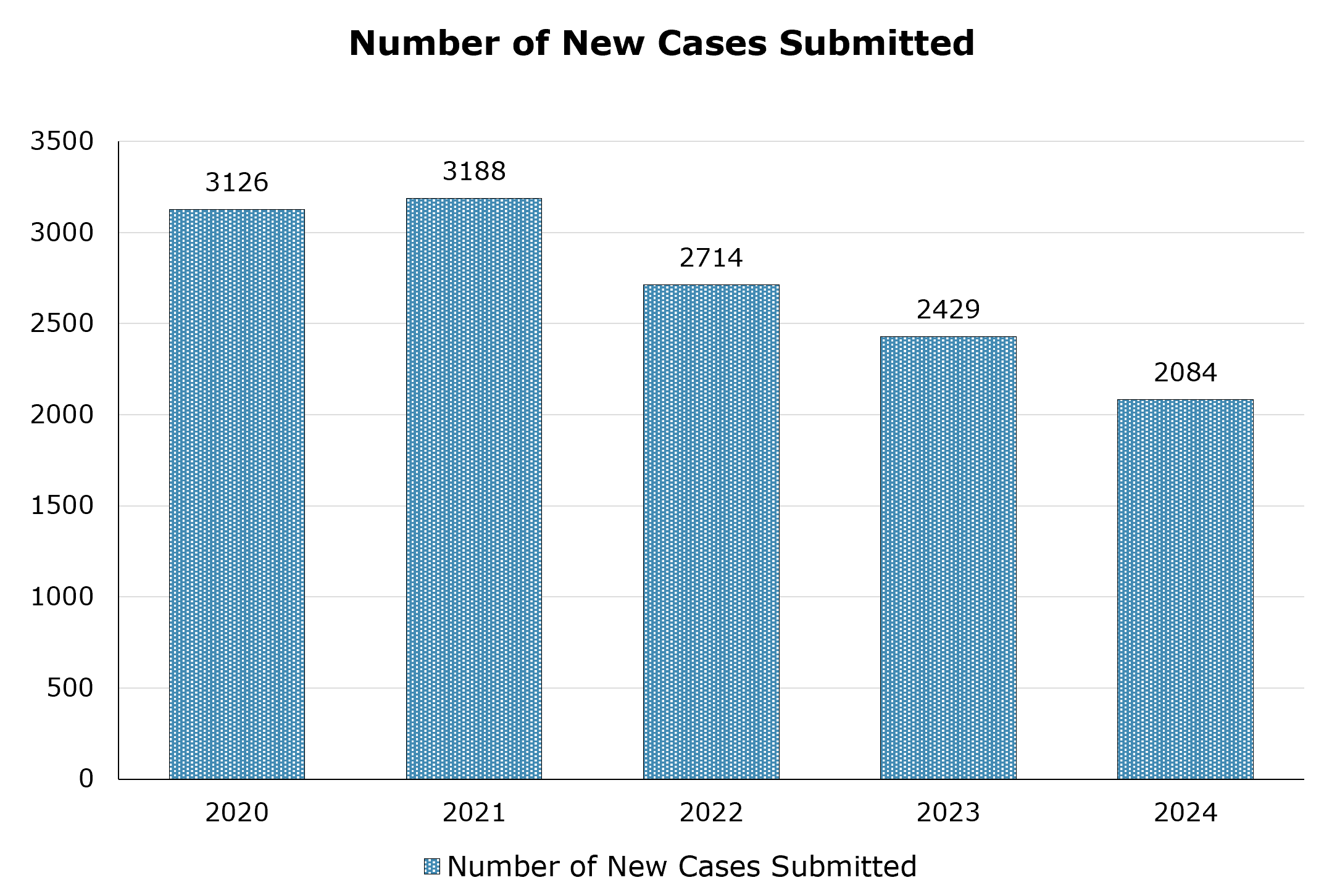
Figure 1 shows that the laboratory received evidence from 3,126 newly initiated cases in 2020, 3,188 in 2021, 2,714 in 2022, 2,429 in 2023, and 2,084 in 2024, reflecting a steady decline following the 2021 peak.
| 2020 | 2021 | 2022 | 2023 | 2024 | |
|---|---|---|---|---|---|
| Number of New Cases | 3136 | 3201 | 2759 | 2486 | 2151 |
| Biology/DNA | Drug ID | Firearms | Fire Debris | Toxicology | |
|---|---|---|---|---|---|
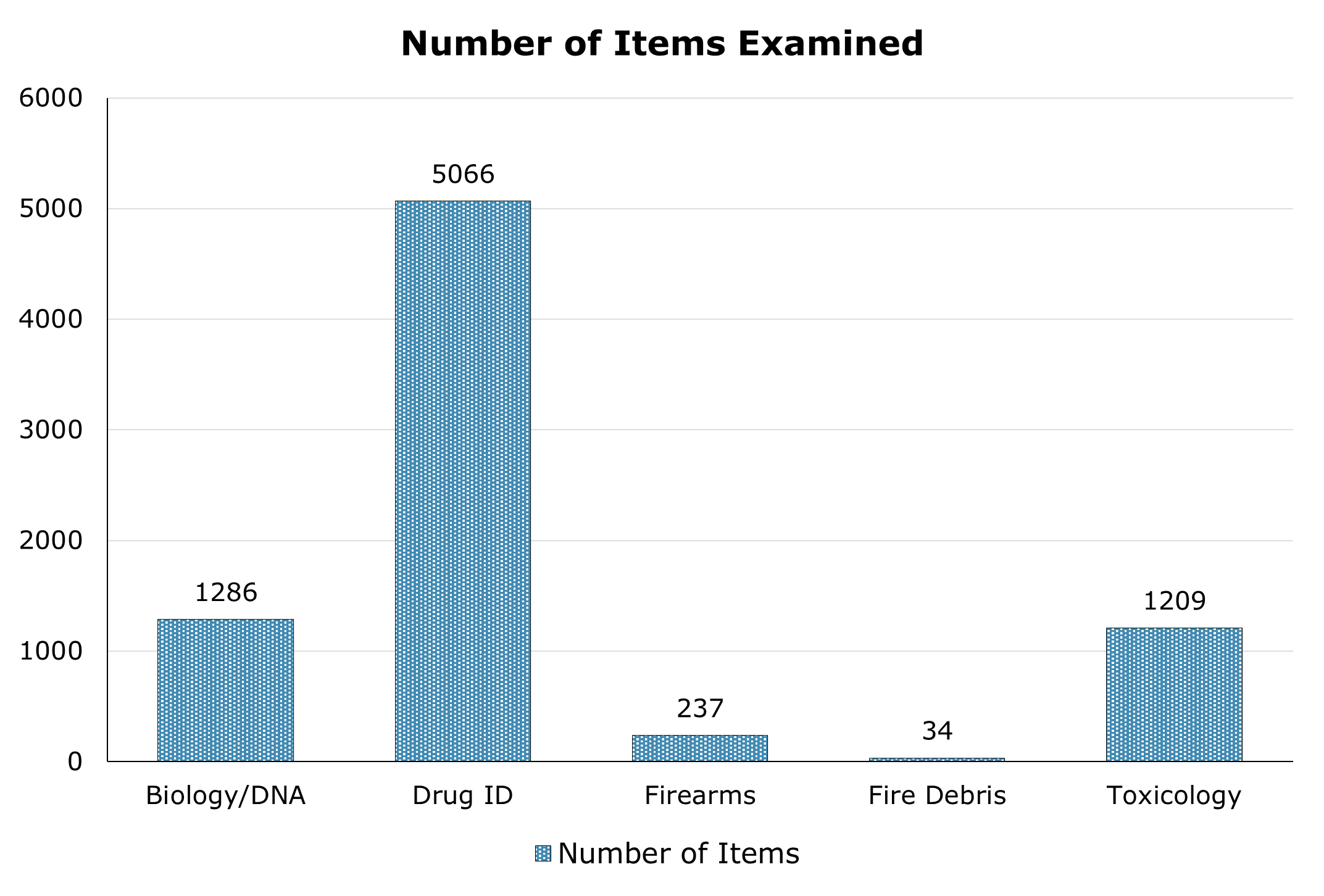
| Number of Items | 1286 | 5066 | 237 | 34 | 1209 |
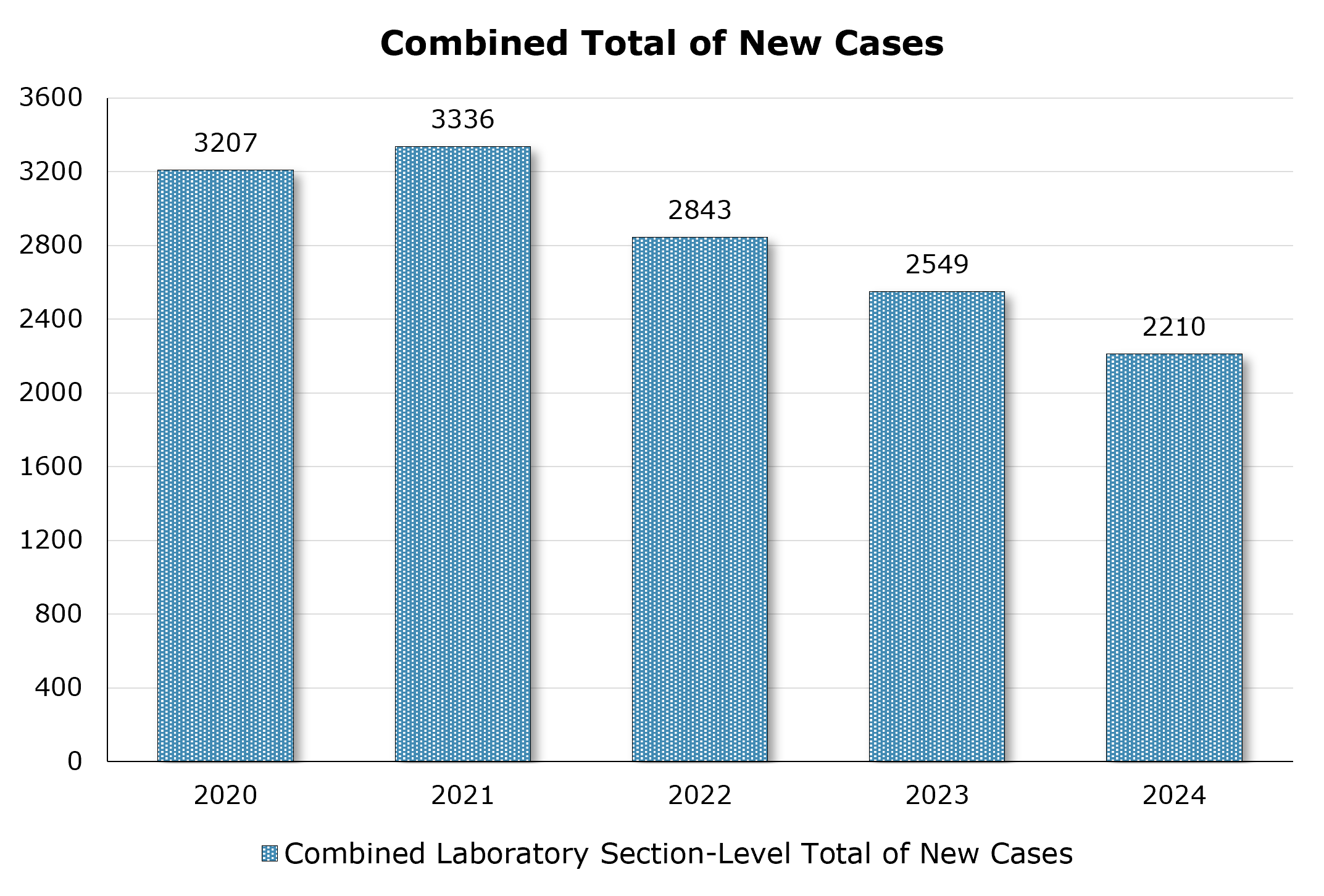
Figure 3 illustrates the combined laboratory section-level total of cases first submitted to the Forensic Laboratory each year, with each case counted once for every laboratory section to which it was submitted. The combined laboratory section-level total of new cases was 3,207 in 2020; 3,336 in 2021; 2,843 in 2022; 2,549 in 2023, and 2,210 in 2024.
| 2020 | 2021 | 2022 | 2023 | 2024 | |
|---|---|---|---|---|---|
| Combined Total | 3228 | 3322 | 2844 | 2554 | 2211 |
Table 2 shows the distribution of newly submitted cases across laboratory sections as follows: Biology/DNA at 9.23 percent, Drug Identification at 34.42 percent, Firearms at 7.01 percent, Fire Debris at 0.63 percent, Toxicology Antemortem at 11.85 percent, and Toxicology Postmortem at 36.86 percent.
| Laboratory Section | Percent of New Case Submissions |
| Biology/DNA | 9.23 |
| Drug Identification | 34.42 |
| Firearms | 7.01 |
| Fire Debris | 0.63 |
| Toxicology Antemortem | 11.85 |
| Toxicology Postmortem | 36.86 |
Table 3 presents a listing of the agencies that submitted evidence to the laboratory division for forensic analysis and the number of new cases that were submitted by each agency in 2024, the total of which is 2,088. The Sedgwick County Coroner submits evidence for analysis on behalf of other County Coroners in support of the regional autopsy service. Out-of-county agencies that submit evidence for analysis are subject to a fee schedule set forth by the Sedgwick County Board of County Commissioners.
| Agency | Number of New Cases |
|---|---|
| Sedgwick County Coroner | 817 |
| Wichita Police Department | 731 |
| Sedgwick County Sheriff's Office | 357 |
| Kansas Highway Patrol | 38 |
| Derby Police Department | 35 |
| Goddard Police Department | 19 |
| Haysville Police Department | 15 |
| Park City Police Department | 15 |
| Wichita Fire Department | 11 |
| Bureau of Alcohol, Tobacco, Firearms and Explosives | 7 |
| Maize Police Department | 7 |
| Bentley Police Department | 5 |
| Clearwater Police Department | 5 |
| Mulvane Police Department | 5 |
| Bel Aire Police Department | 3 |
| Wichita State University Police Department | 3 |
| Colwich Police Department | 2 |
| Goddard USD 365 Police Department | 2 |
| Arkansas City Fire Department | 1 |
| Cheney Police Department | 1 |
| Circle USD 375 Police Department | 1 |
| Department of Homeland Security | 1 |
| Kechi Police Department | 1 |
| Sedgwick County Courthouse Police Department | 1 |
| Sedgwick County Fire Department | 1 |
| Sumner County Sheriff's Office | 1 |
| Valley Center Police Department | 1 |
| Wellington Fire Department | 1 |
| Winfield Police Department | 1 |
The number of new cases accounts for most submissions to the laboratory; however, some cases require subsequent submissions throughout time to assist in answering the forensic questions of the case. The number of submissions in 2024 was 2,415, the combined total of all new and supplemental cases submitted in 2024 was 2,177.
Some cases involved subsequent submissions for additional examination and/or analysis, while others required examination and/or analysis by more than one laboratory section. As such, considering the number of submissions is also useful for assessing services provided.
Table 4 summarizes the percentage of total case submissions attributed to each laboratory section, with cases counted in each section to which they were submitted. Toxicology Postmortem accounted for the highest proportion of submissions at 37.23 percent, followed by Drug Identification at 33.18 percent, Biology/DNA at 12.34 percent, Toxicology Antemortem at 9.56 percent, Firearms at 7.11 percent, and Fire Debris at 0.57 percent.
| Laboratory Section | Percent of Submissions |
|---|---|
| Biology/DNA | 12.34 |
| Drug Identification | 33.18 |
| Firearms | 7.11 |
| Fire Debris | 0.57 |
| Toxicology Postmortem | 37.23 |
| Toxicology Antemortem | 10.37 |
Case Completed
Cases completed every year include cases that are submitted for the first time that year, backlogged cases from previous years, and cases that were originally submitted in previous years but have additional examinations requested.
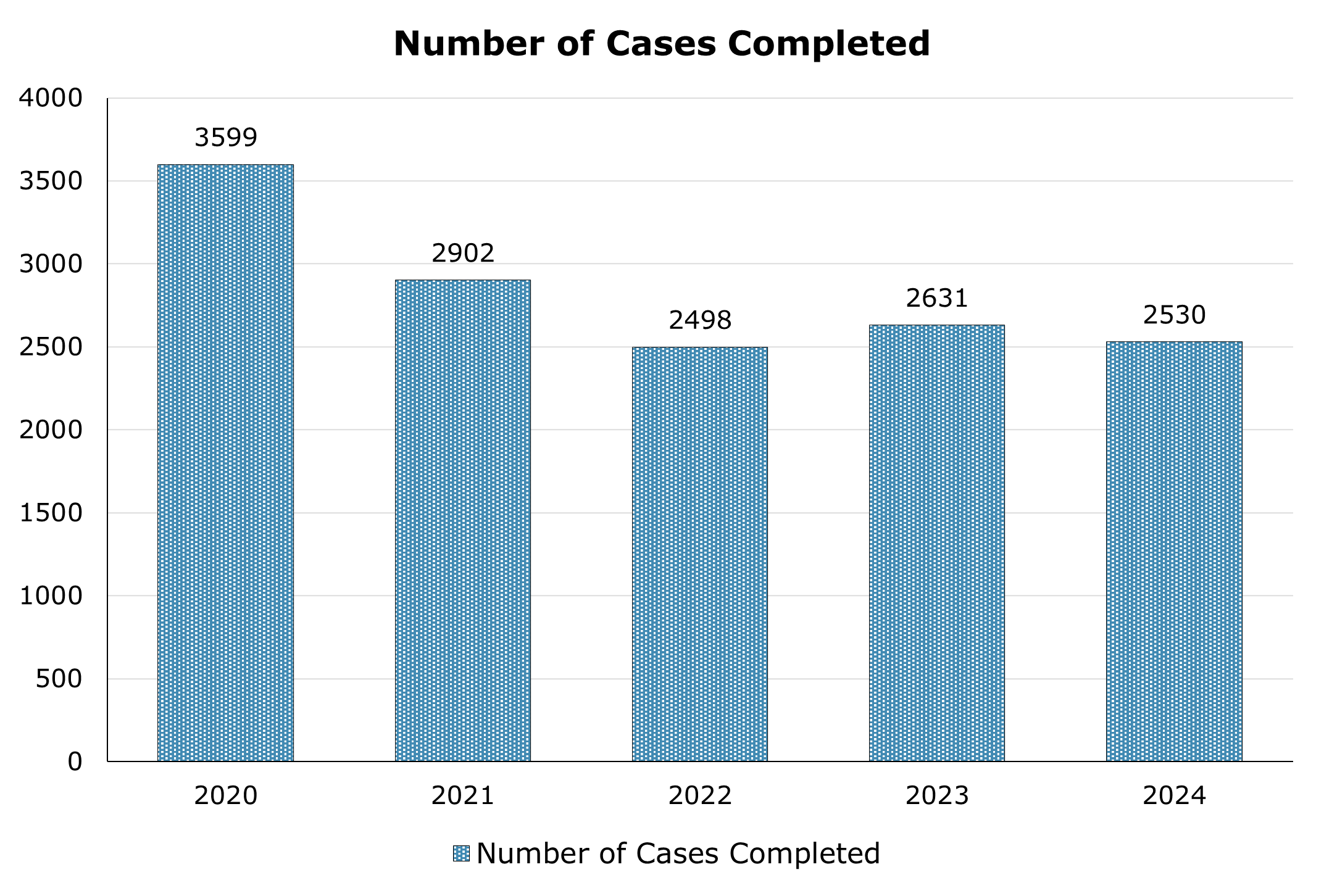
Figure 4 illustrates the number of cases completed by the Forensic Laboratory in the given year. Between 2020 and 2024, the number of completed cases shows an overall downward trajectory, declining from a peak of 3,599 in 2020 to a low of 2,498 in 2022. The 2,530 cases completed in 2024 suggest stabilization in output, indicating that case completion levels remained relatively consistent between 2022 and 2024.
| 2020 | 2021 | 2022 | 2023 | 2024 | |
|---|---|---|---|---|---|
| Number of Cases Completed | 3599 | 2902 | 2498 | 2631 | 2530 |
Case Turnaround Time
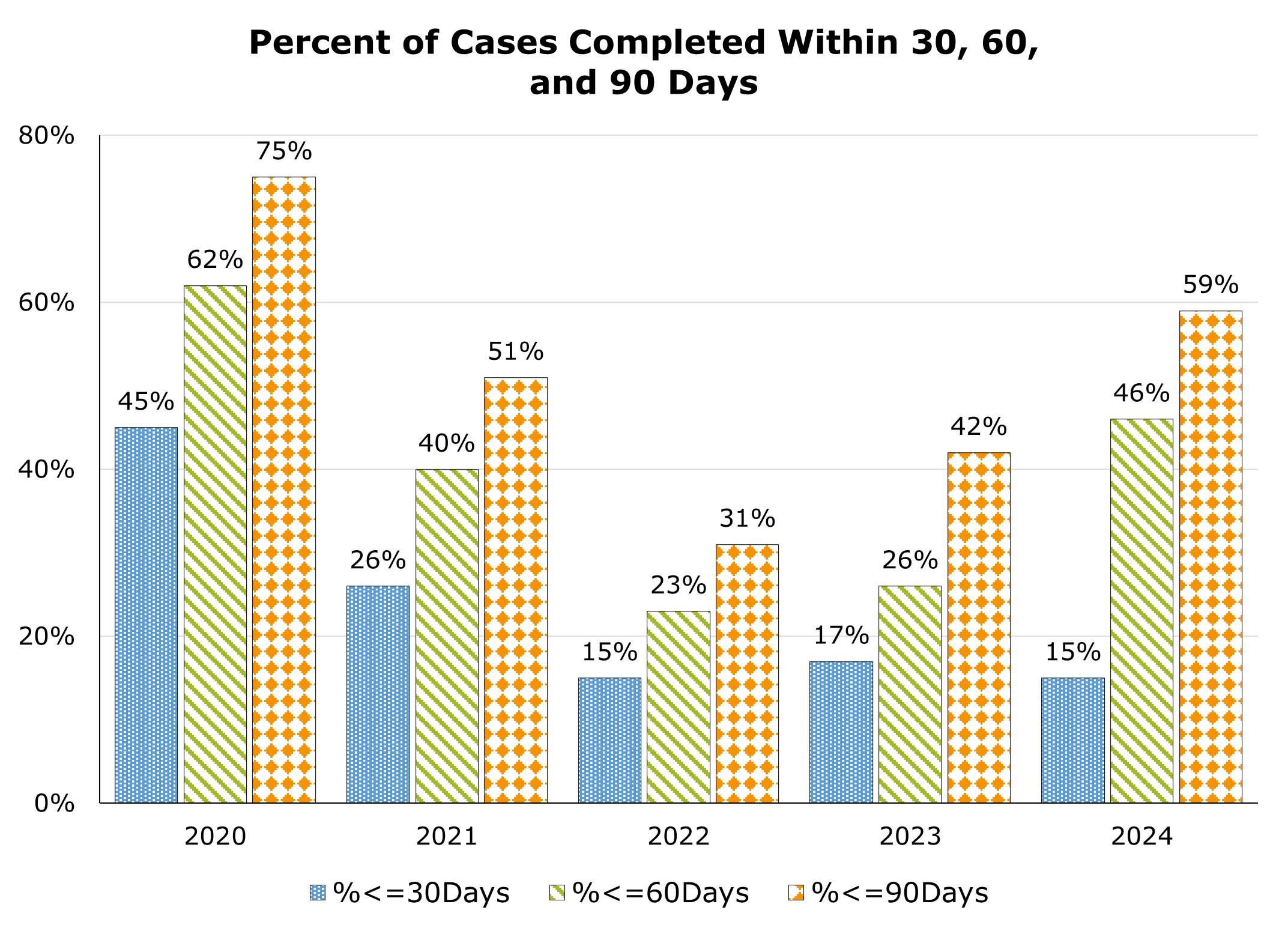
The duration required to finalize Forensic Laboratory casework functions as a quantitative indicator of operational performance. The Forensic Laboratory maintains an internal turnaround time goal of 90 percent of cases completed within 90 days. Figure 5 shows that the proportion of cases completed within 90 days of submission was 75 percent in 2020, declined to 51 percent in 2021, decreased further to 31 percent in 2022, increased slightly to 42 percent in 2023, and rose to 59 percent in 2024. This pattern aligns with the trajectories observed in the 30-day completion metric and the 60-day completion metric, which exhibit similar year-to-year fluctuations.
| 2020 | 2021 | 2022 | 2023 | 2024 | |
|---|---|---|---|---|---|
| Percent less than 30 days | 45 | 26 | 15 | 17 | 15 |
| Percent less than 60 days | 62 | 40 | 23 | 26 | 46 |
| Percent less than 90 days | 75 | 51 | 31 | 42 | 59 |
Backlog
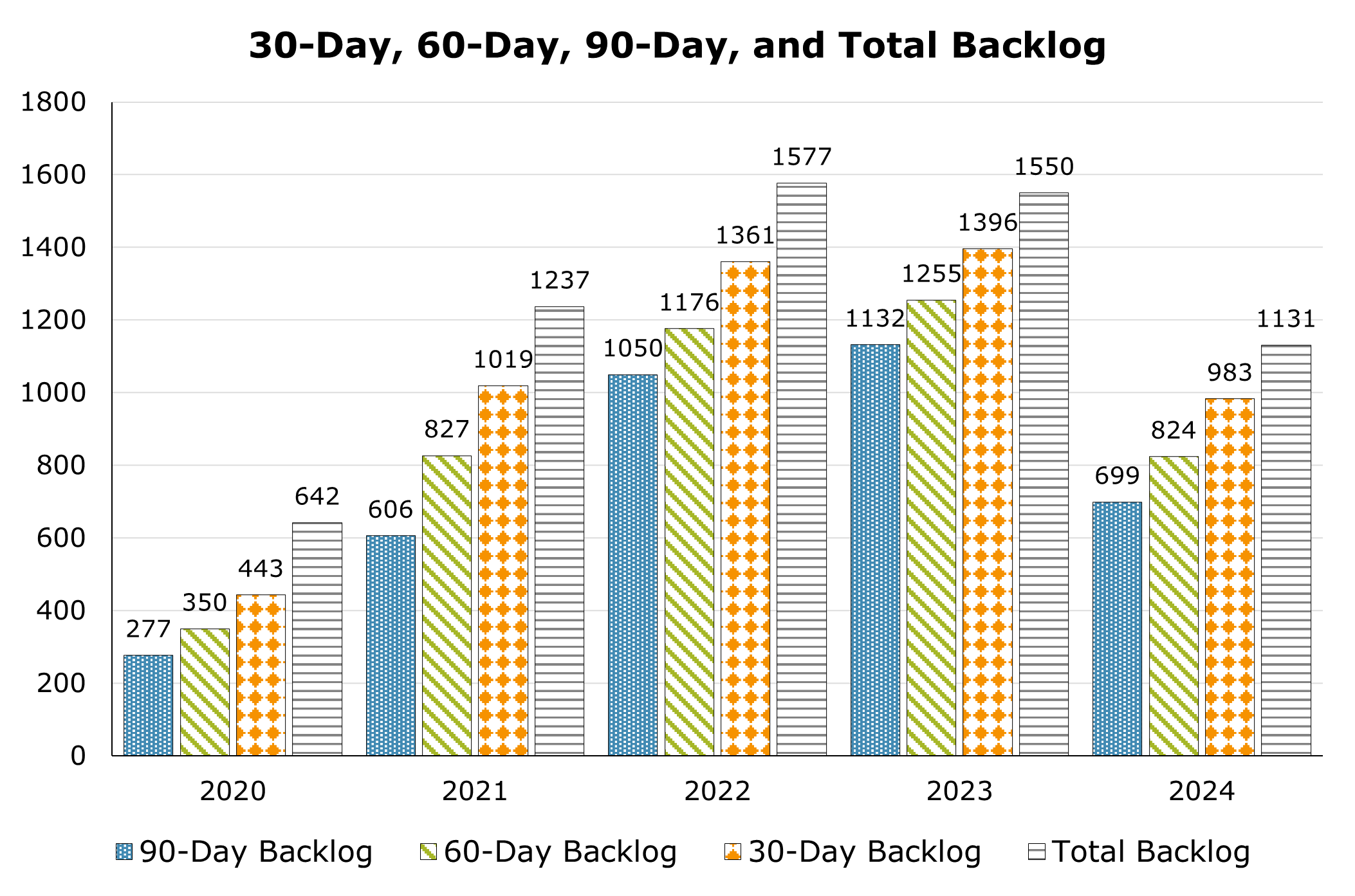
As of December 31, 2024, the laboratory reported a 90-day backlog of 699 cases, a 60-day backlog of 824 cases, a 30-day backlog of 983 cases, and a total backlog of 1,131 cases, as presented in Figure 6. These totals represent a continued reduction in outstanding casework compared with 2022 and 2023 and align closely with the backlog levels recorded at the end of 2021.
| 2020 | 2021 | 2022 | 2023 | 2024 | |
|---|---|---|---|---|---|
| 90-Day Backlog | 277 | 606 | 1050 | 1132 | 699 |
| 60-Day Backlog | 350 | 827 | 1176 | 1255 | 824 |
| 30-Day Backlog | 443 | 1019 | 1361 | 1396 | 983 |
| Total Backlog | 642 | 1237 | 1577 | 1550 | 1131 |
Biology/DNA
The Biology/DNA Laboratory examines evidence from a wide range of case types, including sexual assaults, homicides, property crimes, assaults, and forensic identifications involving unidentified bodies or skeletal remains.
The laboratory screens evidence for the presence of biological material, including blood, semen, and saliva. For DNA analysis, the laboratory develops short tandem repeat (STR) profiles from evidentiary items collected from crime scenes. These profiles may then be compared with reference standards obtained from individuals believed to be associated with the case, such as victims, suspects, or other known individuals. Based on this comparison, conclusions are reached regarding whether the reference standard profiles are consistent with or excluded from the crime scene profiles.
The nature and condition of forensic samples collected at crime scenes can vary substantially. Under optimal conditions, such as with fresh bloodstains, high-quality single-source DNA profiles may be obtained. In other instances, samples may contain biological material from multiple individuals or may have been exposed to environmental conditions that result in low-level and/or degraded DNA. These factors can affect the laboratory’s ability to develop a profile suitable for comparison. When a profile is suitable for comparison, analysts may perform statistical analysis to quantify the significance of an association between a reference sample and a crime scene exhibit and to clearly convey the strength of that association.
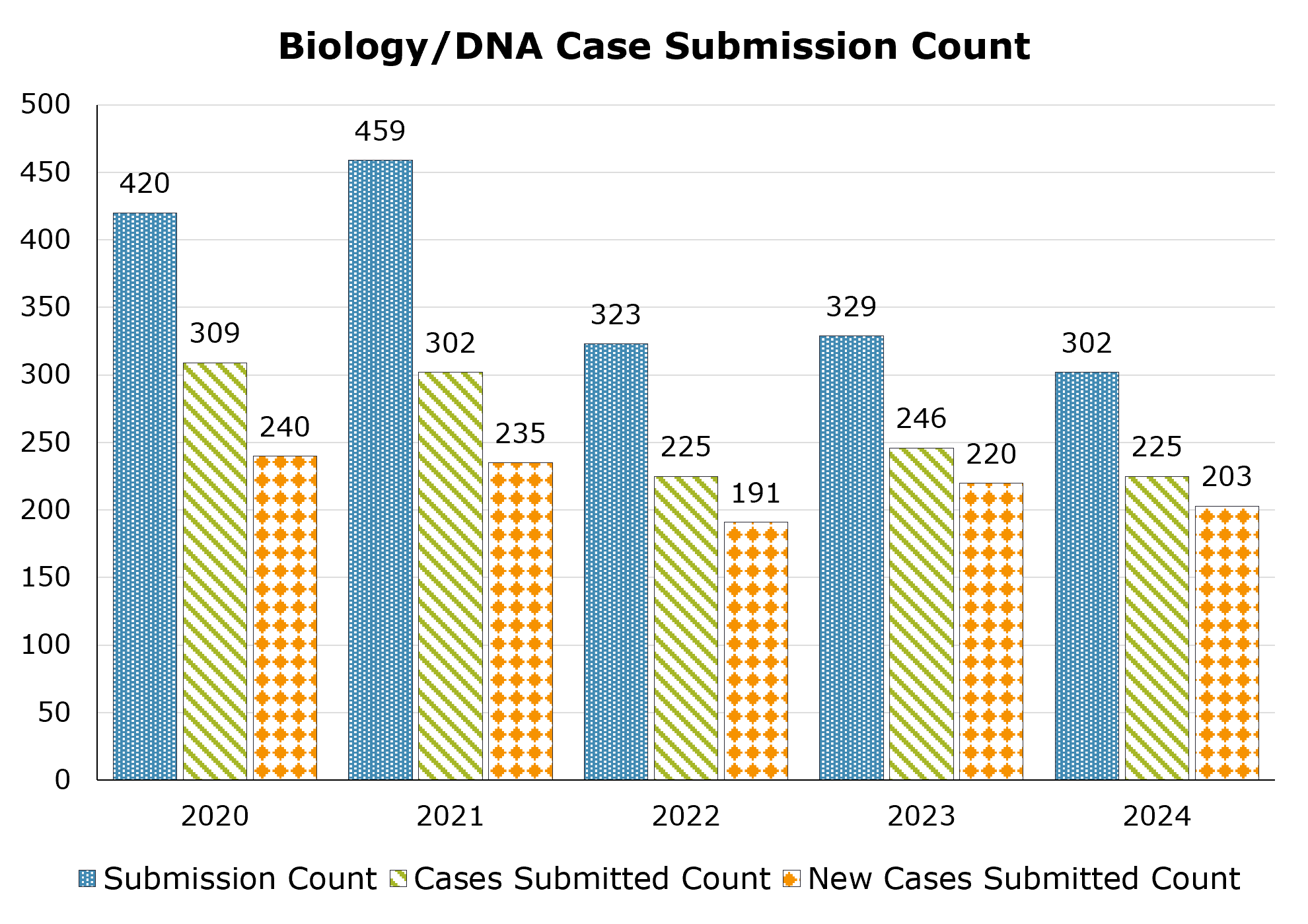
Figure 7 presents three related workload measures for the Biology/DNA Laboratory between 2020 and 2024: the submission count, representing the number of evidence submissions; the cases submitted count, reflecting total unique cases received – including new and previously submitted cases; and the new cases submitted count, indicating first-time case submissions that generate new laboratory case records. In 2024, the laboratory recorded 302 submissions, 225 cases submitted, and 203 new cases submitted. These figures indicate a decline from the 2021 peak but remain relatively stable across the past three years, suggesting that case submissions have begun to level off.
| 2020 | 2021 | 2022 | 2023 | 2024 | |
|---|---|---|---|---|---|
| Submission Count | 420 | 459 | 323 | 329 | 302 |
| Cases Submitted Count | 309 | 302 | 225 | 246 | 225 |
| New Cases Submitted Count | 259 | 227 | 192 | 220 | 204 |
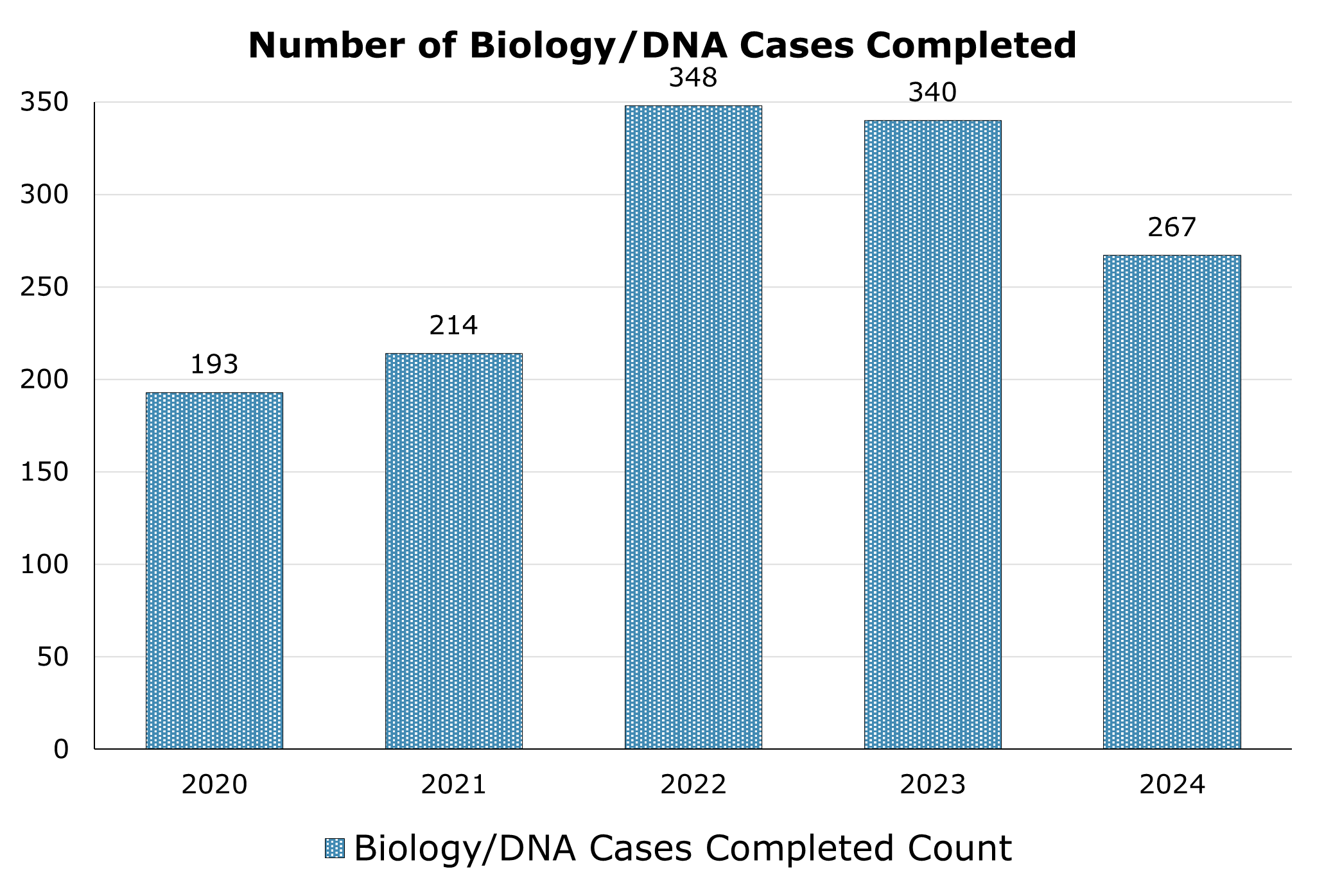
Figure 8 presents the number of cases completed by the Biology/DNA Laboratory from 2020 through 2024. Case completions remained relatively steady in 2020 and 2021, with 193 and 214 cases completed, respectively. Completions then increased substantially in 2022 to 348 cases. In 2023, completions remained relatively stable at 340 cases, followed by a decline to 267 cases in 2024.
| 2020 | 2021 | 2022 | 2023 | 2024 | |
|---|---|---|---|---|---|
| Biology/DNA Case Completed Count | 193 | 214 | 348 | 340 | 267 |
Table 5 illustrates the number of new cases submitted with violation types categorized as either sex crimes, homicides, other violent crimes, property crimes, and identifications. While cases may have multiple violations that overlap between these categories, the table does provide information about the overall number of the categorized case-types the laboratory examined and/or analyzed.
For crimes against persons, sex crime cases were the most common case type submitted for examination. Property crimes continue to have a high likelihood of resulting in a profile suitable for CODIS entry. Given that these crimes have a high recidivism rate they have an exceptional solvability factor when crime scene profiles are searched against the database. In support of the District Coroner, the laboratory identified 17 human decedents through DNA analysis.
| Case Type | Number of Cases |
|---|---|
| Sex Crimes | 112 |
| Homicides | 23 |
| Other Violent Crimes | 30 |
| Property Crimes | 45 |
| Identifications | 17 |
CODIS
The Combined DNA Index System (CODIS) is database software used to compare DNA profiles within and between crime laboratories throughout the nation. In 2007 Kansas became an all-arrestee state, meaning that law enforcement collects DNA samples for any person arrested for qualifying offenses. DNA profiles generated from an arrestee/offender are entered into the state database in Topeka, KS and are available to be searched against the unknown profiles the Biology/DNA laboratory enters into the Local DNA Index System (LDIS). In late 2009, the DNA Laboratory adopted new procedures for the release of investigative lead information to include formal written and reviewed notifications for database associations.
Over the years, the increased number of associations identified through CODIS resulted in an increase in reports generated, as well as an increase in the number of known samples processed to confirm these additional CODIS hits. The number of CODIS entries, associated hits generated, and oversight of this database, entails a large amount of scientist time. Samples compared as a function of database management are not reflected in the number of cases submitted or accounted for as a separate “case type” in the figures describing case submissions.
Trends in CODIS activity are illustrated in Figure 9. In the last 5 years the average number of case profiles entered into CODIS is 119, the average number of hits per year is approximately 68, and the average number of investigations aided per year is approximately 56. Additionally, by the end of 2024 the total number of profiles maintained in LDIS was 2624.
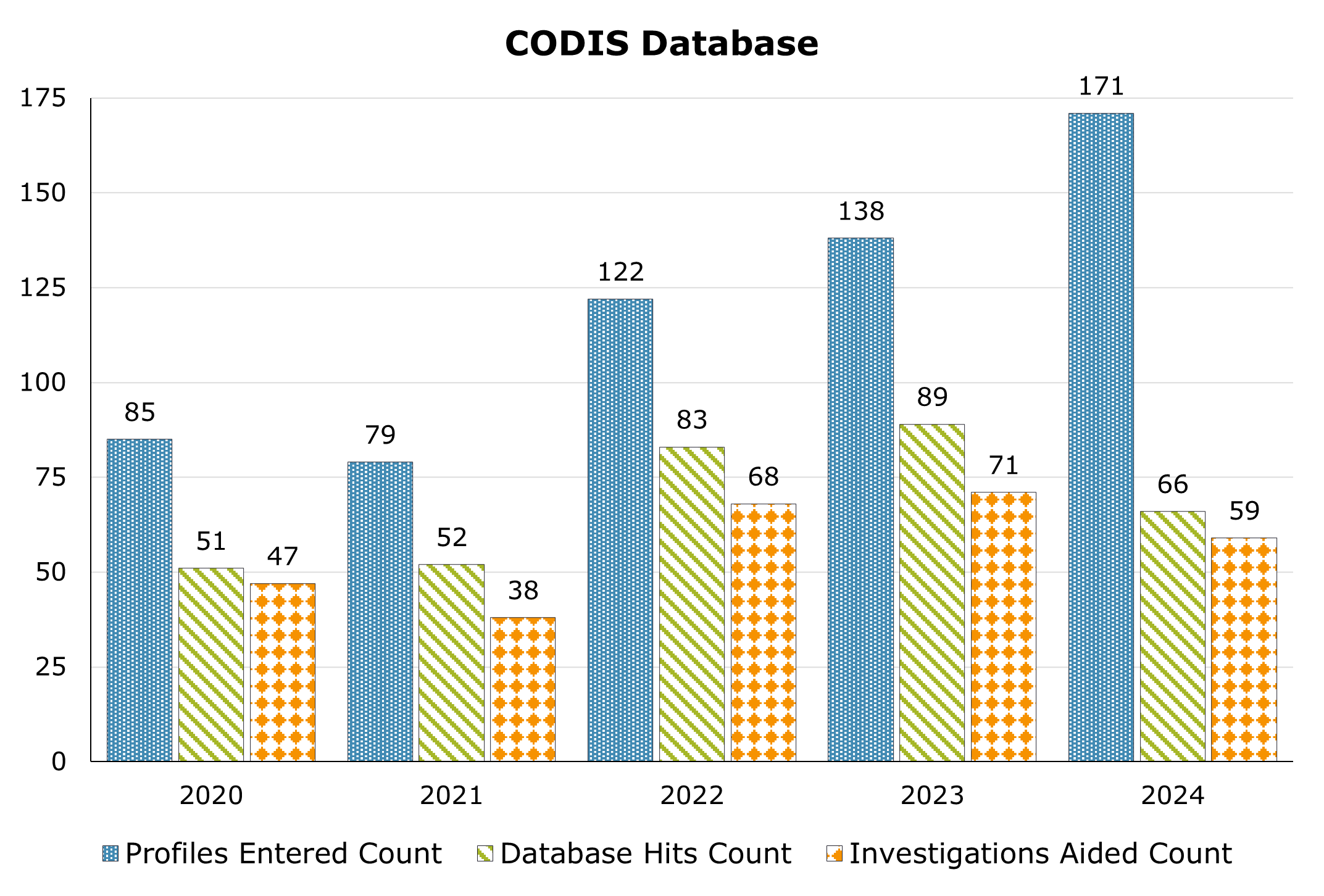
| 2020 | 2021 | 2022 | 2023 | 2024 | |
|---|---|---|---|---|---|
| Profiles Entered Count | 85 | 79 | 122 | 138 | 171 |
| Database Hits Count | 51 | 52 | 83 | 89 | 66 |
| Investigations Aided Count | 47 | 38 | 68 | 71 | 59 |
Criminalistics
The Criminalistics Unit conducts forensic examinations in Drug Identification, Firearms, and Fire Debris. Of the cases submitted to the unit, Drug Identification accounted for 77.45 percent, Firearms for 20.77 percent, and Fire Debris for 1.78 percent.
Drug ID
The Drug Identification (Drug ID) Laboratory specializes in the analysis of unknown substances seized by law enforcement to determine whether they are illegal controlled substances. The laboratory provides scientific support for criminal investigations, including substance identification and the determination of the purity and quantity of analyzed materials.
Figure 10 presents three related workload measures for the Drug ID Laboratory between 2020 and 2024: the submission count, representing the number of evidence submissions; the cases submitted count, reflecting total unique cases received – including new and previously submitted cases; and the new cases submitted count, indicating first-time case submissions that generate new laboratory case records. In 2024, the laboratory recorded 812 submissions, 784 cases submitted, and 760 new cases submitted. These figures continue the downward trajectory observed since the peak submission year of 2021.
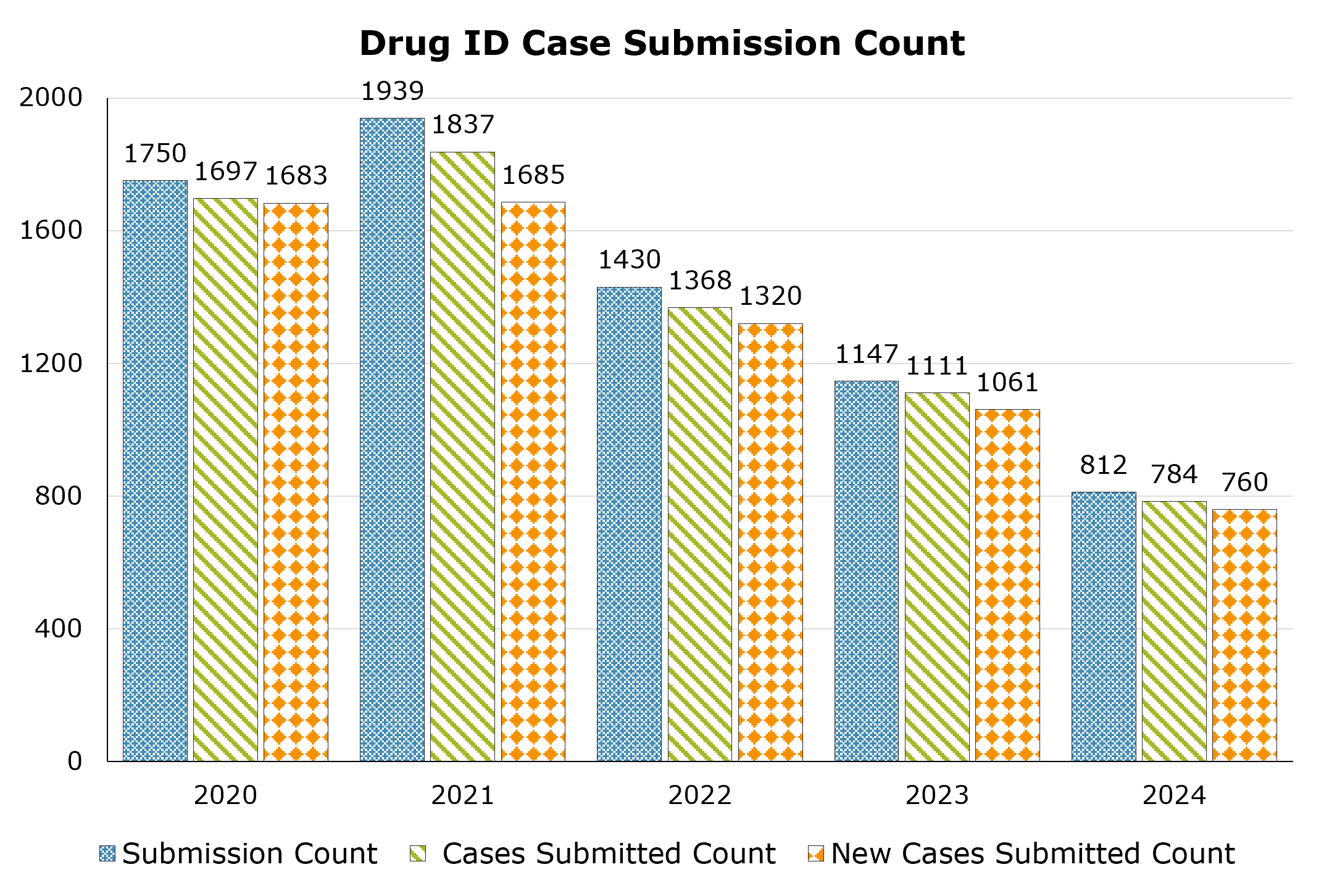
| 2020 | 2021 | 2022 | 2023 | 2024 | |
|---|---|---|---|---|---|
| Submission Count | 1750 | 1939 | 1437 | 1185 | 812 |
| Cases Submitted Count | 1697 | 1837 | 1375 | 1149 | 784 |
| New Cases Submitted Count | 1683 | 1684 | 1321 | 1065 | 761 |
The Wichita Police Department accounted for the largest share of case submissions to the Drug ID Laboratory at 48.15 percent, followed by the Sedgwick County Sheriff’s Office at 35.71 percent.
Figure 11 presents the number of cases completed by the Drug ID Laboratory from 2020 through 2024. The overall pattern reflects a sustained decline, with completions falling from 2,323 cases in 2020 to 1,056 cases in 2024. However, the 2024 total represents an increase relative to the lowest point in the series—797 completed cases in 2022—indicating a partial recovery in output.
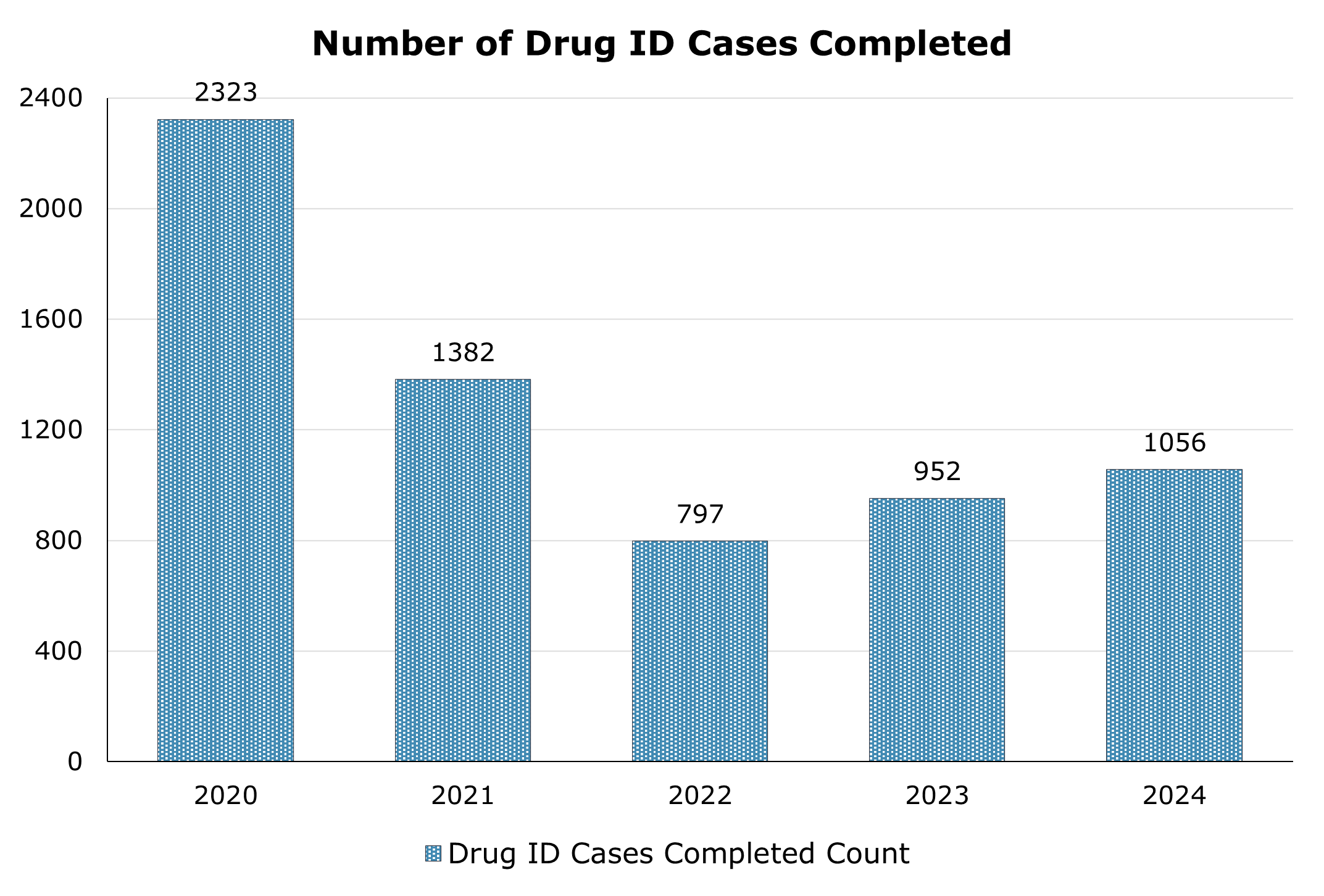
| 2020 | 2021 | 2022 | 2023 | 2024 | |
|---|---|---|---|---|---|
| Drug ID Cases Completed Count | 2323 | 1382 | 797 | 952 | 1056 |
Firearms
Firearm examination is conducted in support of state and federal law enforcement. The Firearms Laboratory conducts many types of forensic examinations, including function testing, bullet and projectile comparison, cartridge case comparison, and serial number restoration. The majority, 87.09 percent, of examinations involve operability (function) tests on the submitted firearms.
Figure 12 presents three related workload measures for the Firearms Laboratory between 2020 and 2024: the submission count, representing the number of evidence submissions; the cases submitted count, reflecting total unique cases received – including new and previously submitted cases; and the new cases submitted count, indicating first-time case submissions that generate new laboratory case records. In 2024, the laboratory recorded 174 submissions, 158 cases submitted, and 156 new cases submitted. These figures show an upward trajectory compared to the previous four years.
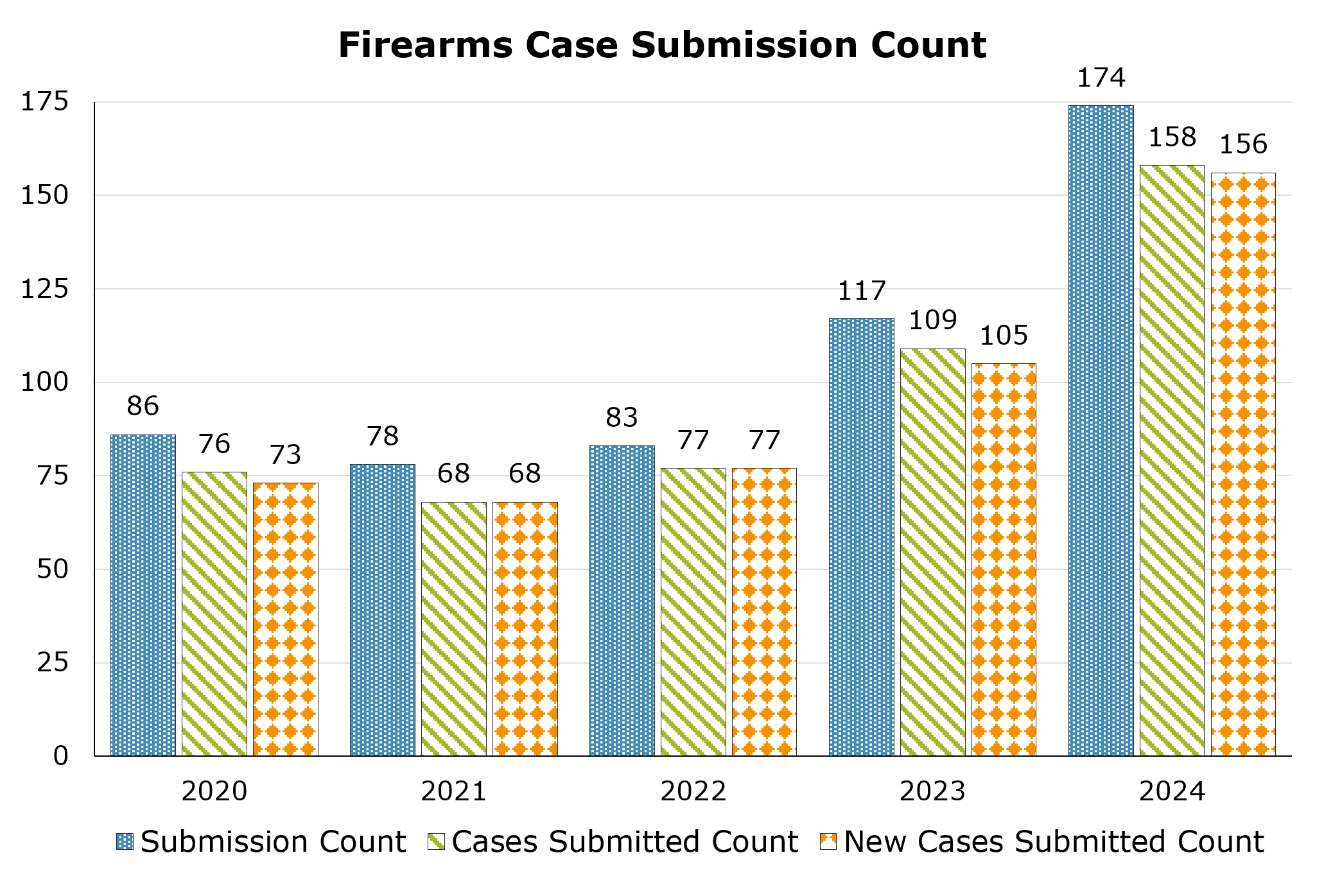
| 2020 | 2021 | 2022 | 2023 | 2024 | |
|---|---|---|---|---|---|
| Submission Count | 86 | 78 | 89 | 117 | 174 |
| Cases Submitted Count | 76 | 68 | 83 | 109 | 158 |
| New Cases Submitted | 73 | 67 | 77 | 106 | 155 |
Table 6 shows the number of each examination type—function tests, bullet/projectile comparisons, cartridge case comparisons, and serial number restorations—requested from 2022 through 2024. Overall, requests for all examination types increased during this period, except for serial number restorations, which declined slightly from 2022 but remained consistent with the 2023 level.
| Function Test | Bullet/Projectile Comparison | Cartridge Case Comparison | Serial Number Restoration | |
|---|---|---|---|---|
| 2022 | 73 | 3 | 5 | 5 |
| 2023 | 95 | 14 | 19 | 2 |
| 2024 | 136 | 49 | 64 | 2 |
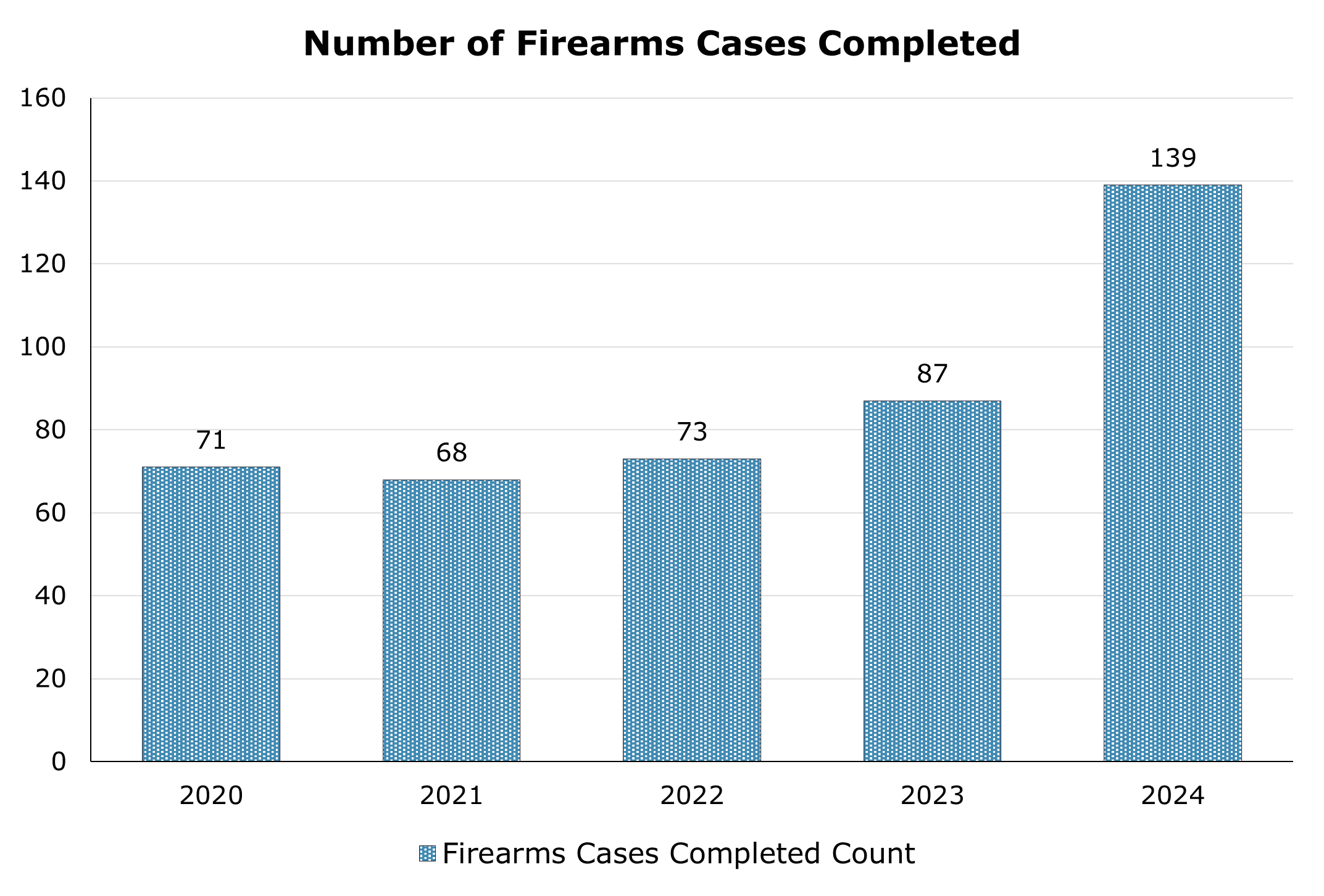
Figure 13 shows the number of cases completed by the Firearms Laboratory from 2020 through 2024. The overall pattern reflects a sustained increase, with completions climbing from 71 cases in 2020 to 139 cases in 2024.
| 2020 | 2021 | 2022 | 2023 | 2024 | |
|---|---|---|---|---|---|
| Firearms Cases Completed Count | 71 | 68 | 73 | 87 | 139 |
Fire Debris
The Fire Debris Laboratory examines fire debris evidence in support of fire investigations. The information provided to the investigator assists in determining if a fire was accidentally or intentionally set for purposes ranging from insurance fraud to homicide.
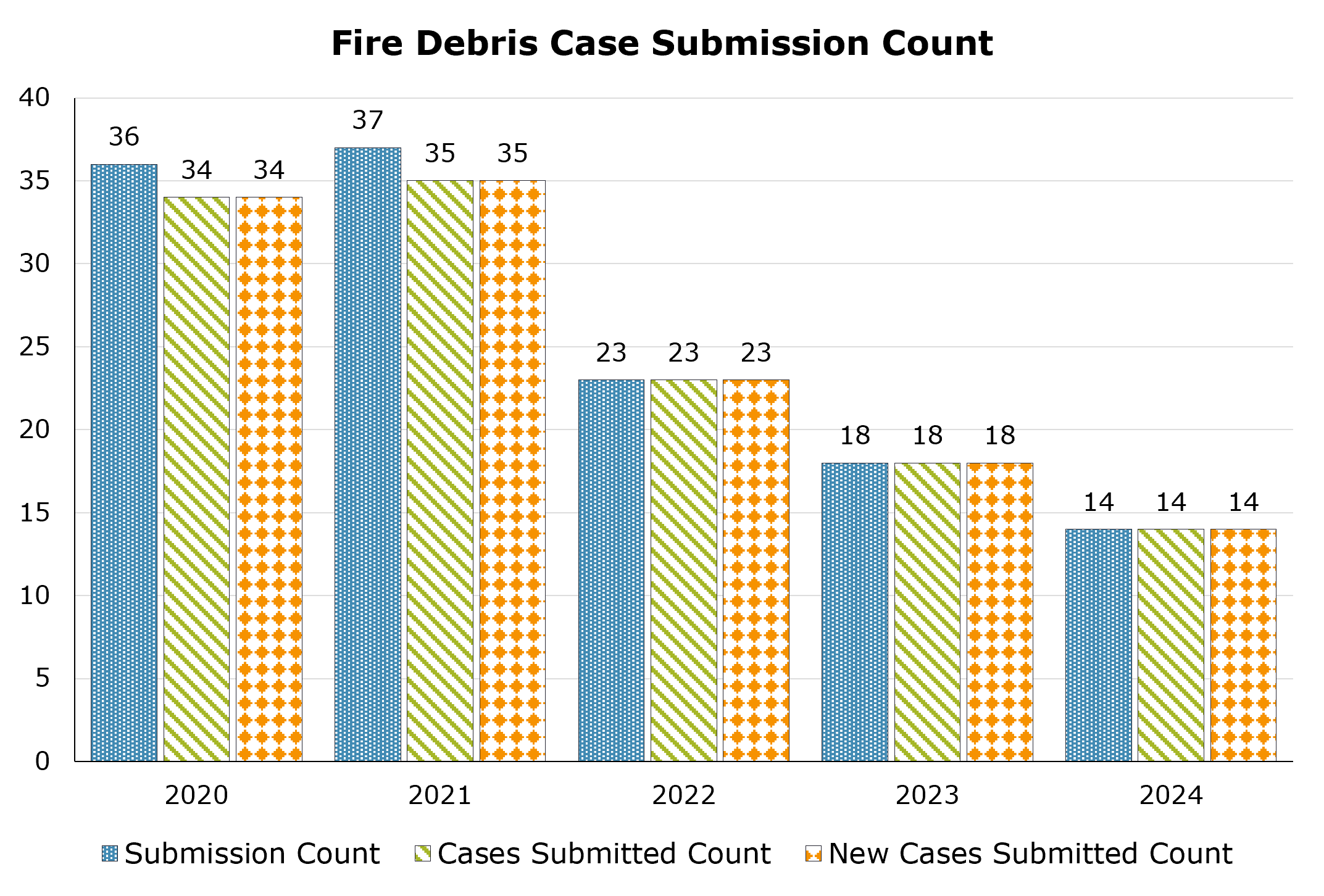
Figure 14 presents three related workload measures for the Fire Debris Laboratory between 2020 and 2024: the submission count, representing the number of evidence submissions; the cases submitted count, reflecting total unique cases received – including new and previously submitted cases; and the new cases submitted count, indicating first-time case submissions that generate new laboratory case records. In 2024, the laboratory recorded 14 submissions, 14 cases submitted, and 14 new cases submitted. These figures continue the downward trajectory observed since the peak submission year of 2021.
| 2020 | 2021 | 2022 | 2023 | 2024 | |
|---|---|---|---|---|---|
| Submission Count | 36 | 37 | 24 | 22 | 14 |
| Cases Submitted Count | 34 | 35 | 24 | 22 | 14 |
| New Cases Submitted Count | 34 | 35 | 23 | 18 | 14 |
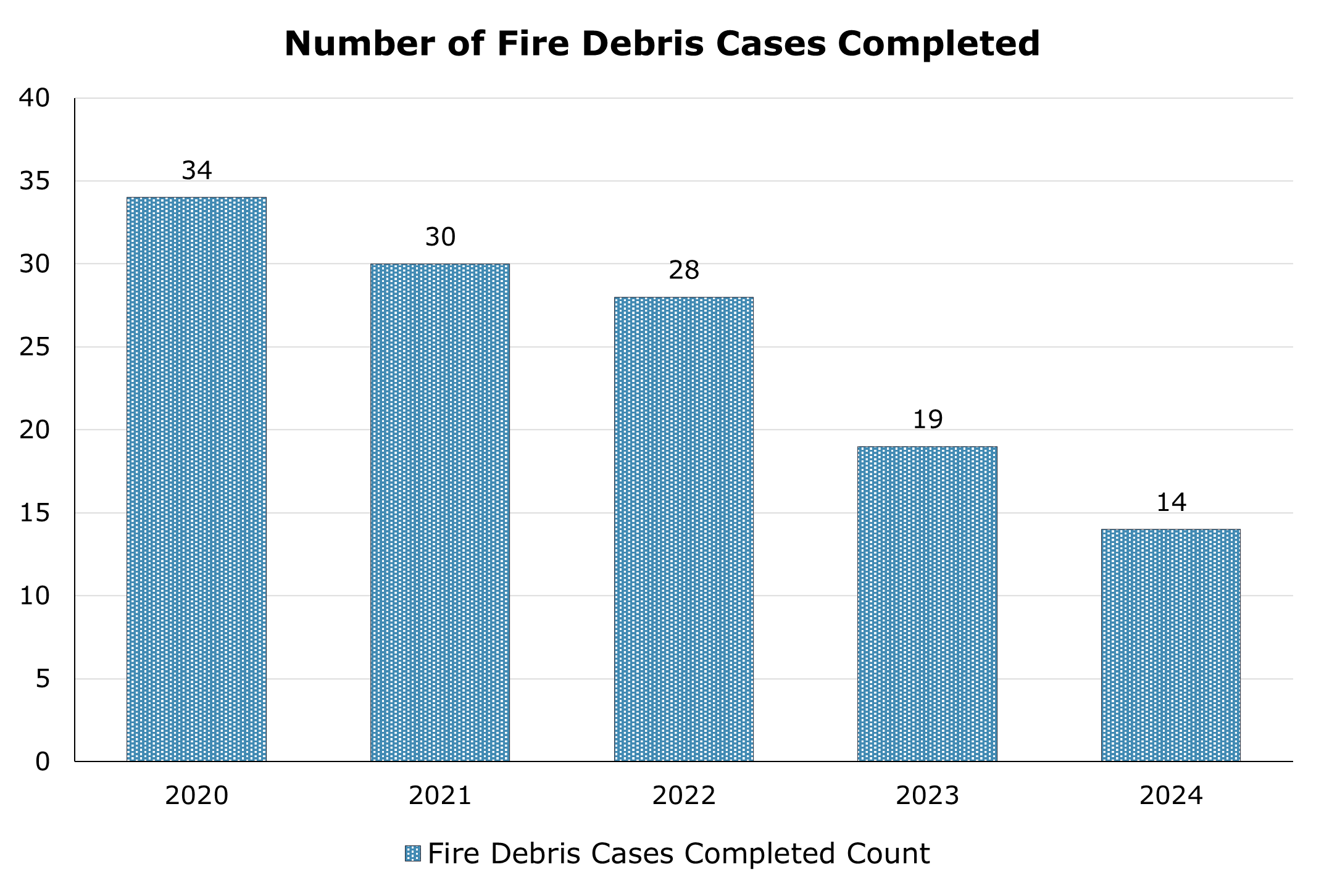
Figure 15 shows the number of cases completed by the Fire Debris Laboratory from 2020 through 2024. The overall pattern reflects a sustained decline, with completions falling from 34 cases in 2020 to 14 cases in 2024.
| 2020 | 2021 | 2022 | 2023 | 2024 | |
|---|---|---|---|---|---|
| Fire Debris Cases Completed Count | 34 | 30 | 28 | 19 | 14 |
Toxicology
The Toxicology Laboratory provides comprehensive examinations of postmortem (autopsy) samples to assist in the determination of cause and manner of death. The remaining portion of cases are antemortem cases submitted by law enforcement for analysis. These include driving under the influence of alcohol (DUI), driving under the influence of drug (DUID), drug-facilitated sexual assault (DFSA), and other case types.
Due to the continuously emerging drugs that are available for use and/or abuse, the laboratory is constantly expanding the number of drugs and poisons it can detect and quantitate.
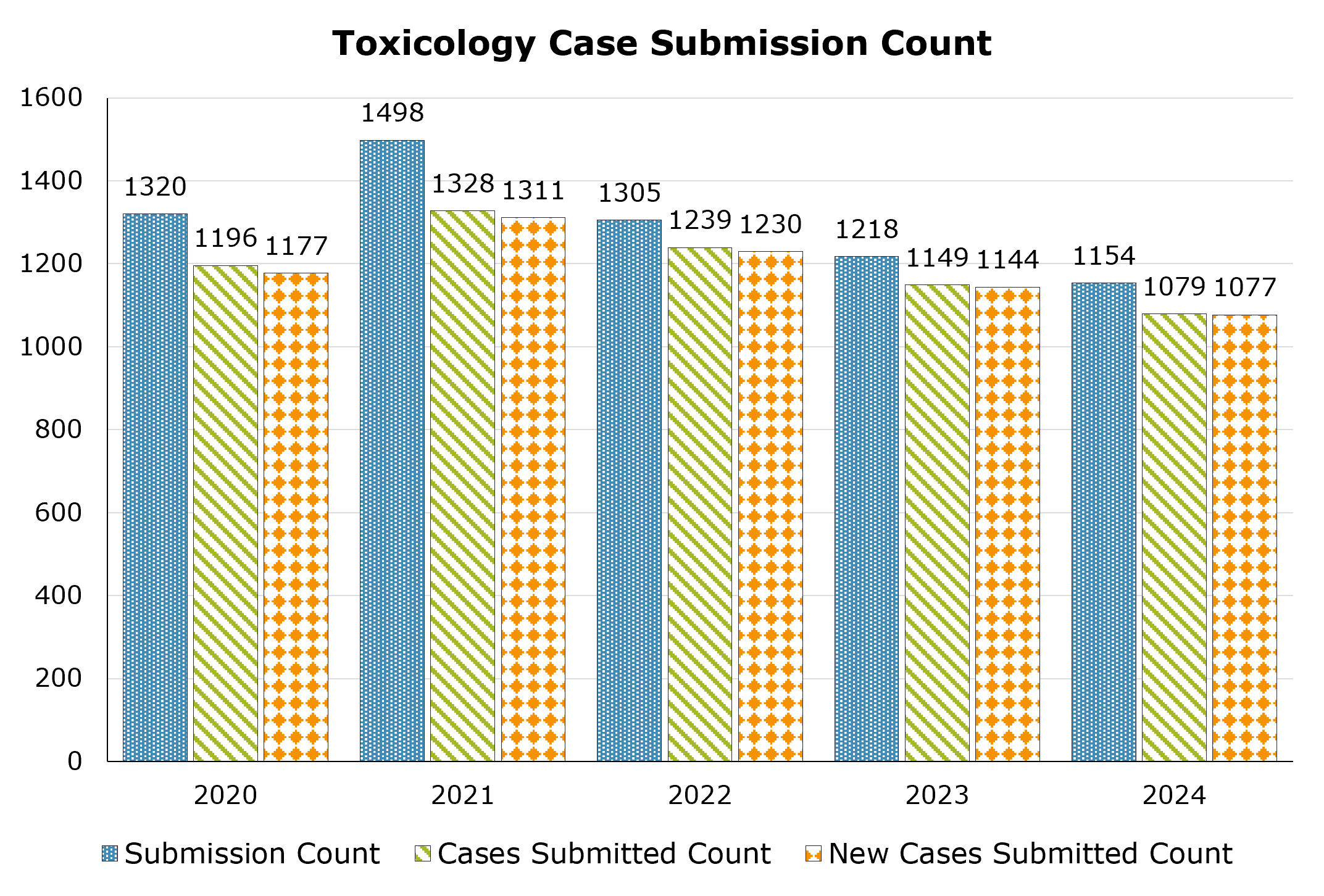
Figure 16 presents three related workload measures for the Toxicology Laboratory between 2020 and 2024: the submission count, representing the number of evidence submissions; the cases submitted count, reflecting total unique cases received – including new and previously submitted cases; and the new cases submitted count, indicating first-time case submissions that generate new laboratory case records. In 2024, the laboratory recorded 1,154 submissions, 1,079 cases submitted, and 1,077 new cases submitted. These figures indicate a decline from the 2021 peak but remain relatively stable across the remaining three years, suggesting that the peak seen in 2021 had a higher-than-normal number of case submissions.
Postmortem toxicological examinations in support of the District Coroner account for approximately 75.67 percent of the newly submitted cases that were submitted to the Toxicology Laboratory. The percentage of antemortem toxicological examinations in support of law enforcement investigations accounted for 24.32 percent, with 22.74 percent being for driving (DUI/DUID) cases, 0.83 percent being for drug-facilitated sexual assaults (DFSA) cases, and 0.74 percent being for all other case types.
| 2020 | 2021 | 2022 | 2023 | 2024 | |
|---|---|---|---|---|---|
| Submission Count | 1320 | 1498 | 1305 | 1218 | 1154 |
| Cases Submitted Count | 1196 | 1328 | 1238 | 1149 | 1079 |
| New Cases Submitted Count | 1185 | 1303 | 1230 | 1145 | 1077 |
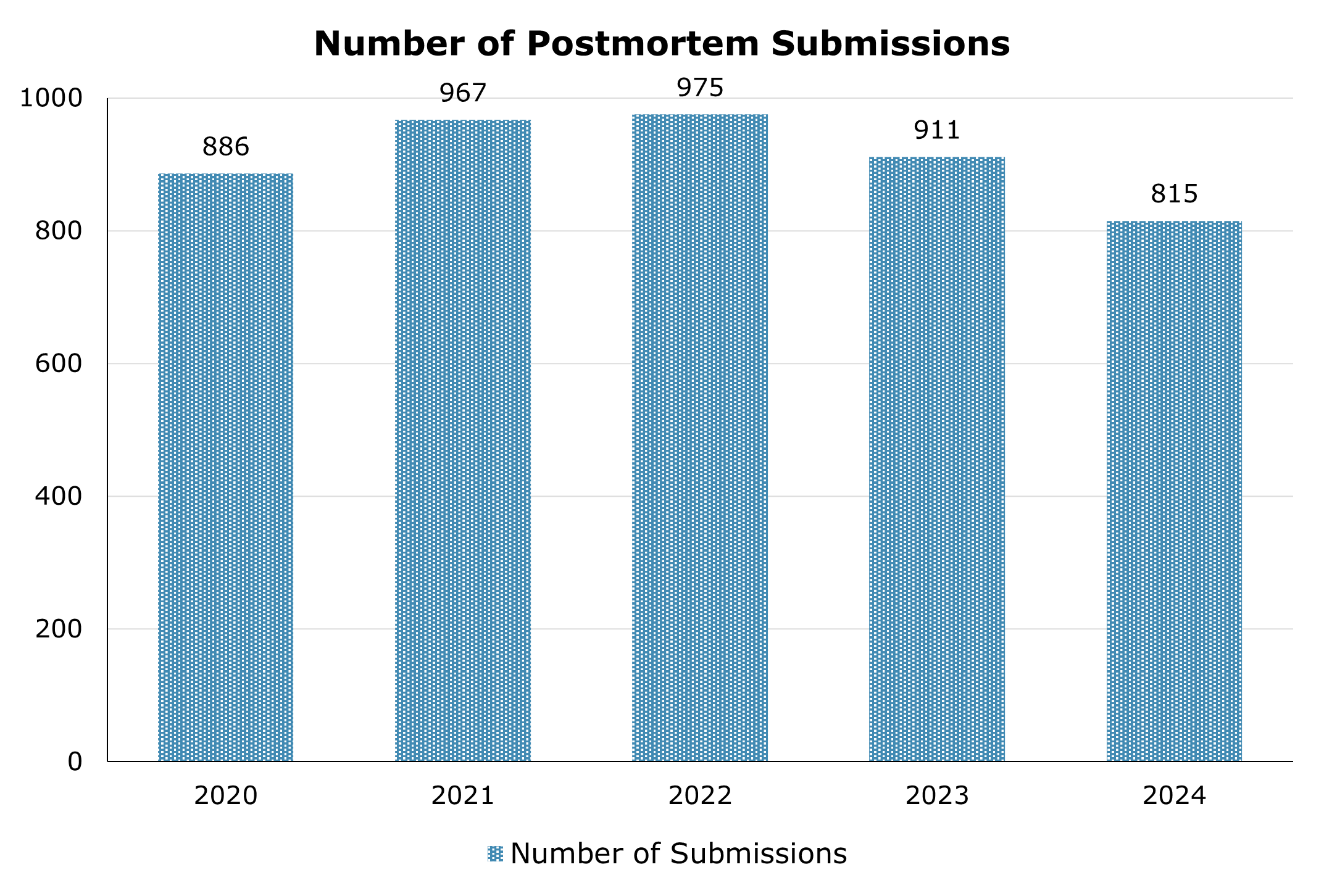
Figure 17 illustrates the number of new postmortem case submissions to the Toxicology Laboratory between 2020 and 2024. The number of new postmortem submissions trended downward over this period, with the highest total occurring in 2022 at 975 cases and the 2024 total at 815.
| 2020 | 2021 | 2022 | 2023 | 2024 | |
|---|---|---|---|---|---|
| Number of Submissions | 886 | 967 | 975 | 911 | 815 |
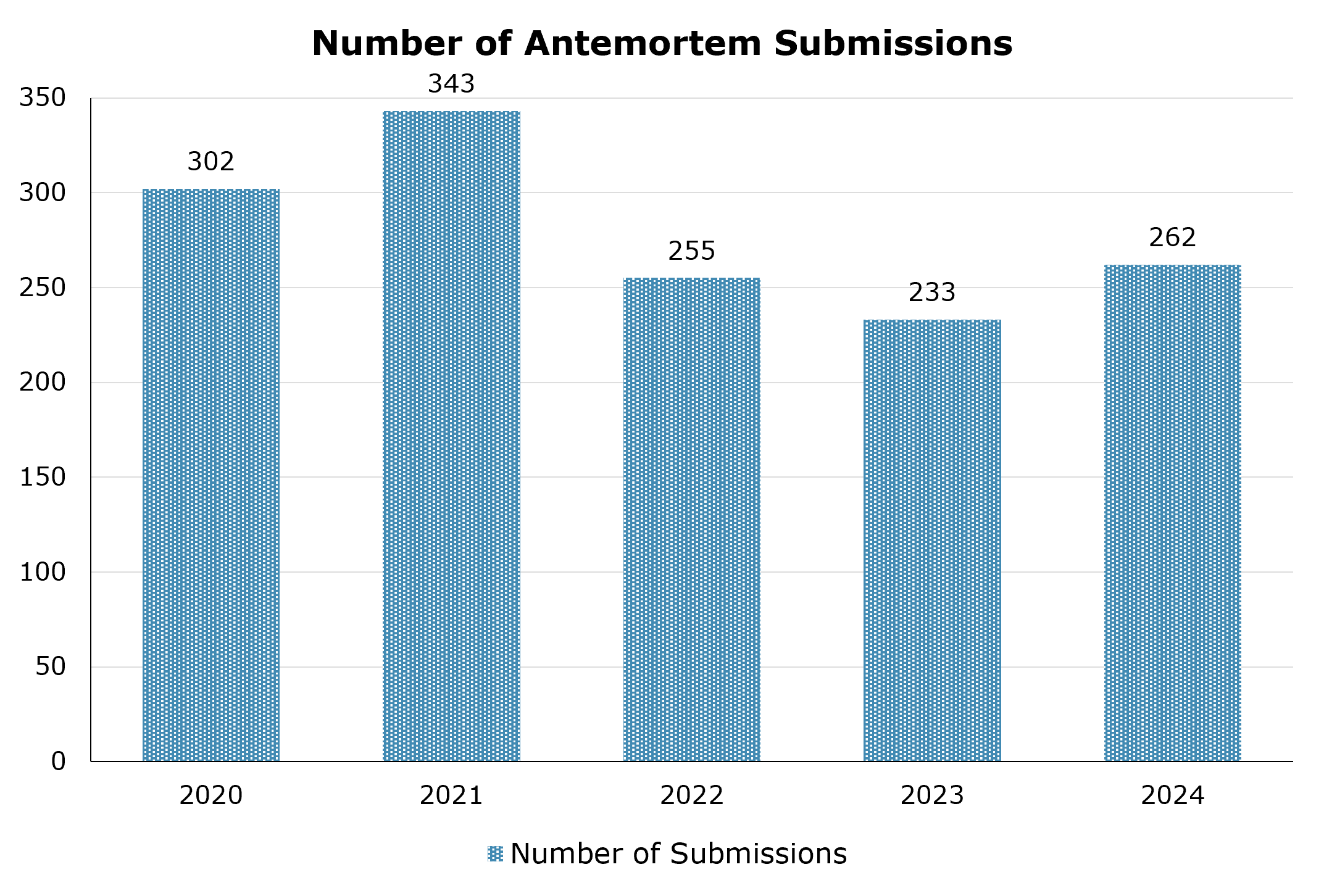
Figure 18 illustrates the number of new antemortem case submissions to the Toxicology Laboratory between 2020 and 2024. Antemortem submissions also trended downward during this period, with the highest number occurring in 2021 at 343 cases and the 2024 total at 262 cases.
| 2020 | 2021 | 2022 | 2023 | 2024 | |
|---|---|---|---|---|---|
| Number of Submissions | 302 | 343 | 256 | 234 | 262 |
Postmortem Drugs Detected
Hundreds of different drugs can be confirmed in Postmortem Toxicology cases, including a wide range of illicit, prescription, and over the counter drugs. New drugs are constantly emerging on the illicit drug market providing a challenge to the Toxicology Laboratory. Table 7 illustrates the most frequently confirmed drugs and/or metabolites in 2024 cases. Of the 815 cases submitted, there were a total of 142 different drugs and/or metabolites confirmed in 571 cases with confirmed analytical results.
| Drugs Detected in Postmortem Cases | Case Count |
| Ethanol | 174 |
| Methamphetamine | 165 |
| Amphetamine | 150 |
| Fentanyl | 140 |
| Norfentanyl | 124 |
| Delta-9 THC | 102 |
| 4-ANPP | 88 |
| Delta-9 Carboxy-THC | 88 |
| Benzoylecgonine | 76 |
| Naloxone | 58 |
| Oxycodone | 35 |
| Cocaine | 32 |
| Delta-8 THC | 24 |
| Amiodarone | 23 |
| Diphenydramine | 23 |
Drug-Related Deaths
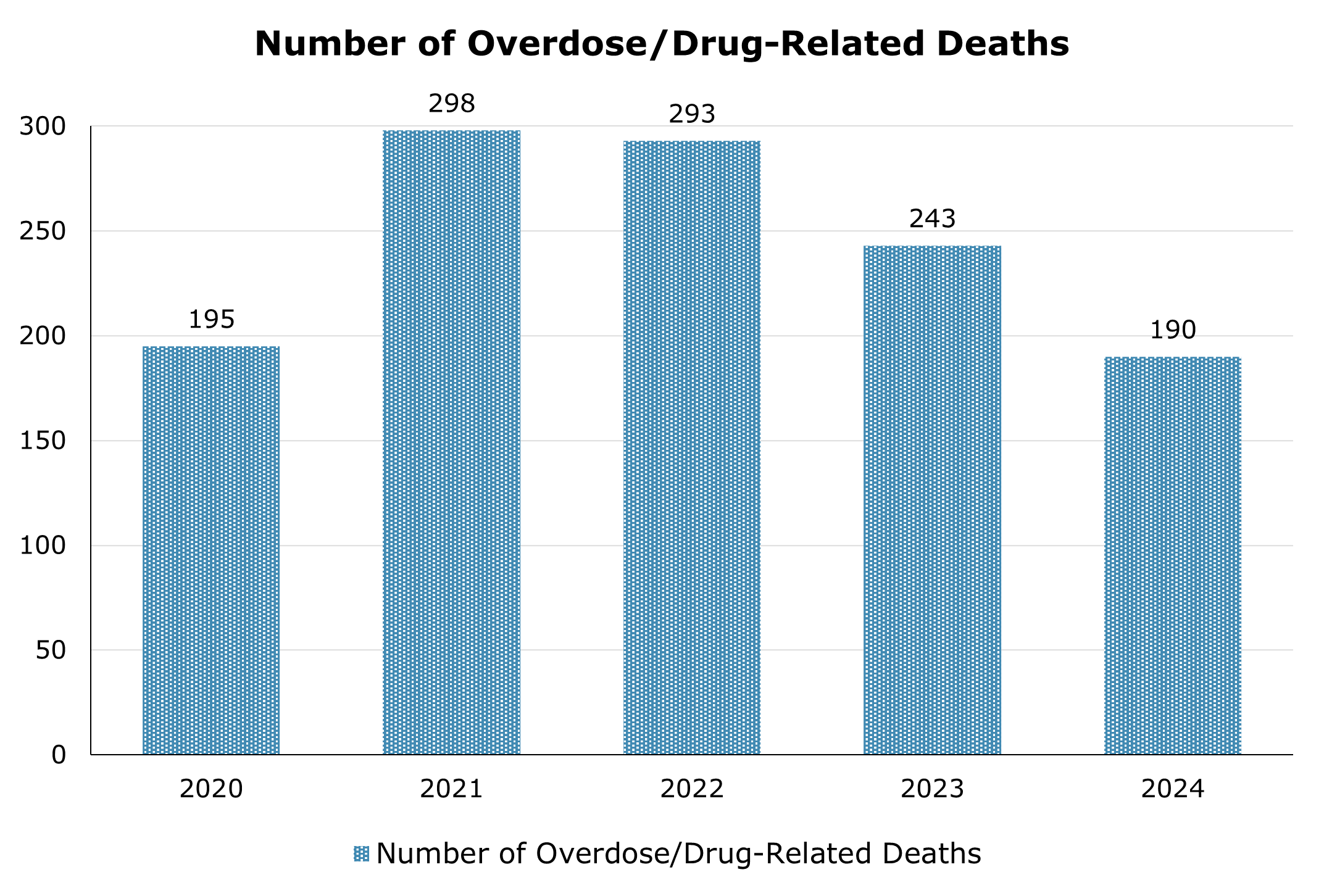
Drug-related deaths can be either accidental or intentional. Methamphetamine or opioids, including fentanyl, are frequently identified and analytically confirmed by the Toxicology Laboratory in biological specimens collected at autopsy. Over the period between 2020 and 2024 there has been an overall downward trend in the number of overdose/drug-related deaths. The number of these types of deaths was 195 in 2020 and in 2024 the number was 190. However, as shown in Figure 19 the 2024 number of drug-related deaths is down from the all-time high of 298 in 2021.
| 2020 | 2021 | 2022 | 2023 | 2024 | |
|---|---|---|---|---|---|
| Number of Drug-Related Deaths | 195 | 298 | 293 | 243 | 190 |
Opioid Positive Drug-Related Deaths
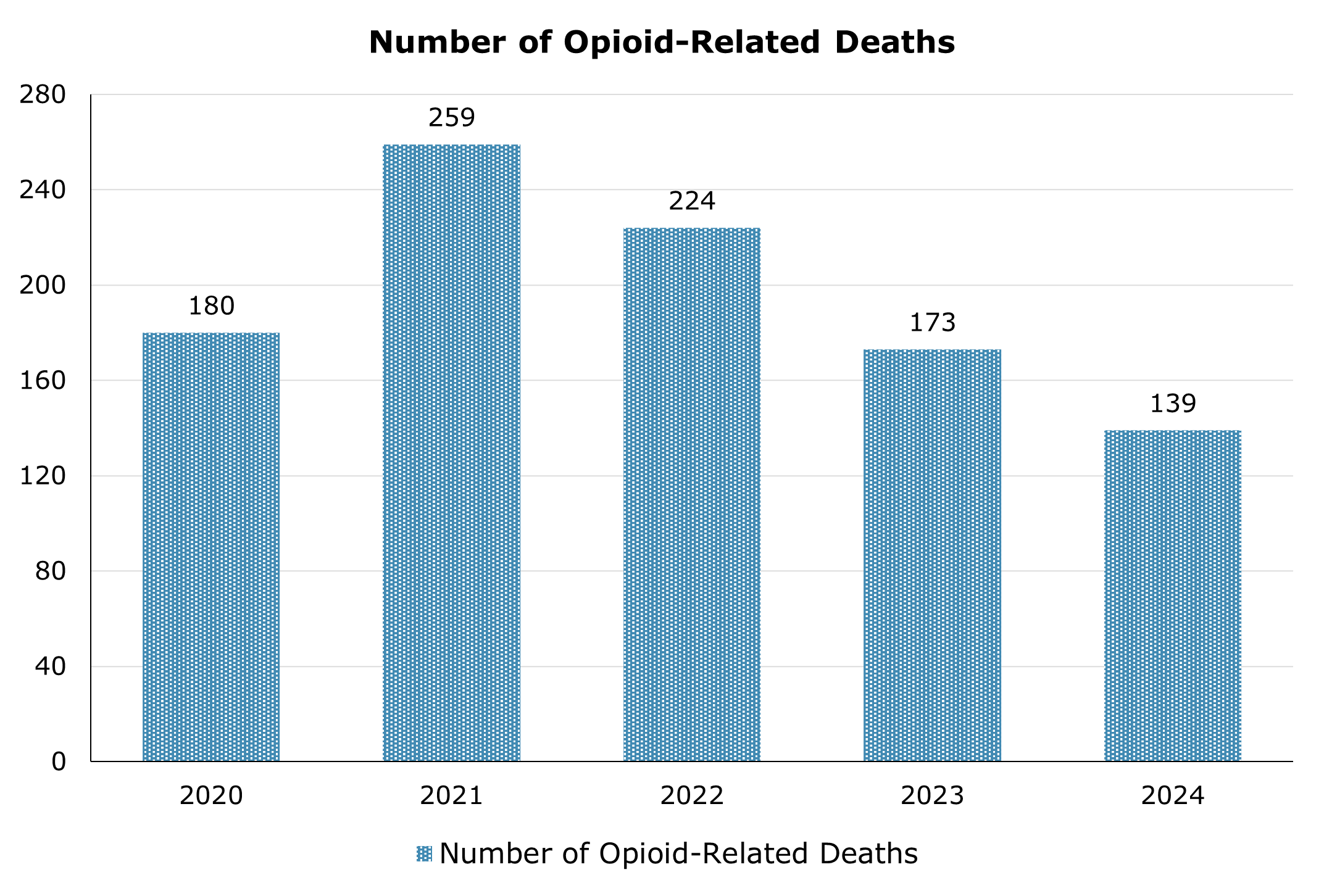
Figure 20 illustrates the number of drug-related deaths that tested positive for an opioid between 2020 and 2024. As illustrated, in 2024 the number of opioid deaths continued to trend downwards when compared to 2021 and 2022. In 2024, there were 139 opioid positive drug related deaths compared to 259 in 2021.
| 2020 | 2021 | 2022 | 2023 | 2024 | |
|---|---|---|---|---|---|
| Number of Opioid-Related Deaths | 180 | 259 | 224 | 173 | 139 |
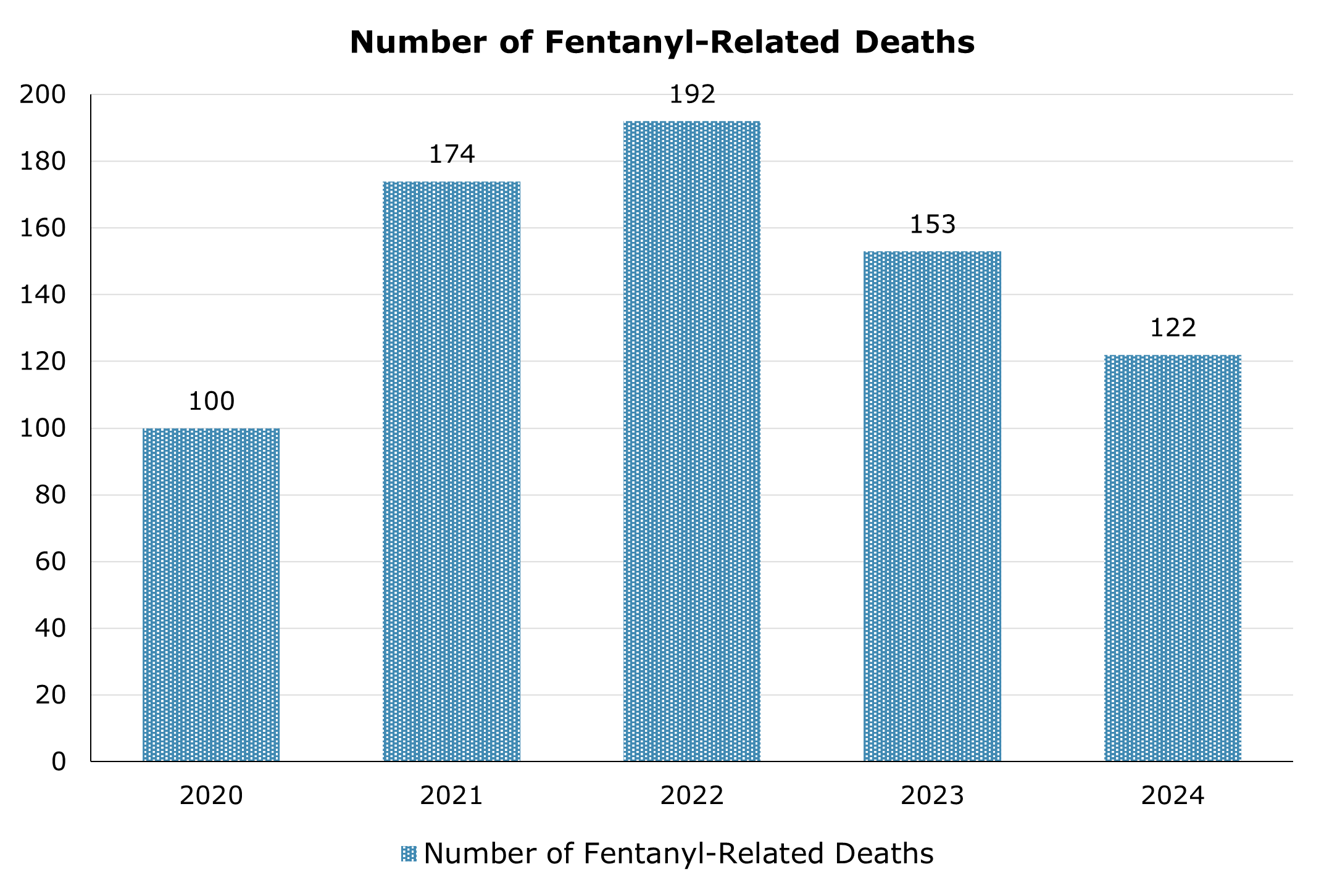
Figure 21 illustrates the number of fentanyl-related deaths between 2020 and 2024. Fentanyl remained the most frequently analytically confirmed opioid in postmortem cases. In 2024, there were 122 fentanyl-related deaths, reflecting a sustained decline from the peak of 192 in 2022.
| 2020 | 2021 | 2022 | 2023 | 2024 | |
|---|---|---|---|---|---|
| Number of Fentanyl-Related Deaths | 100 | 174 | 192 | 153 | 122 |
Methamphetamine Positive Drug-Related Deaths
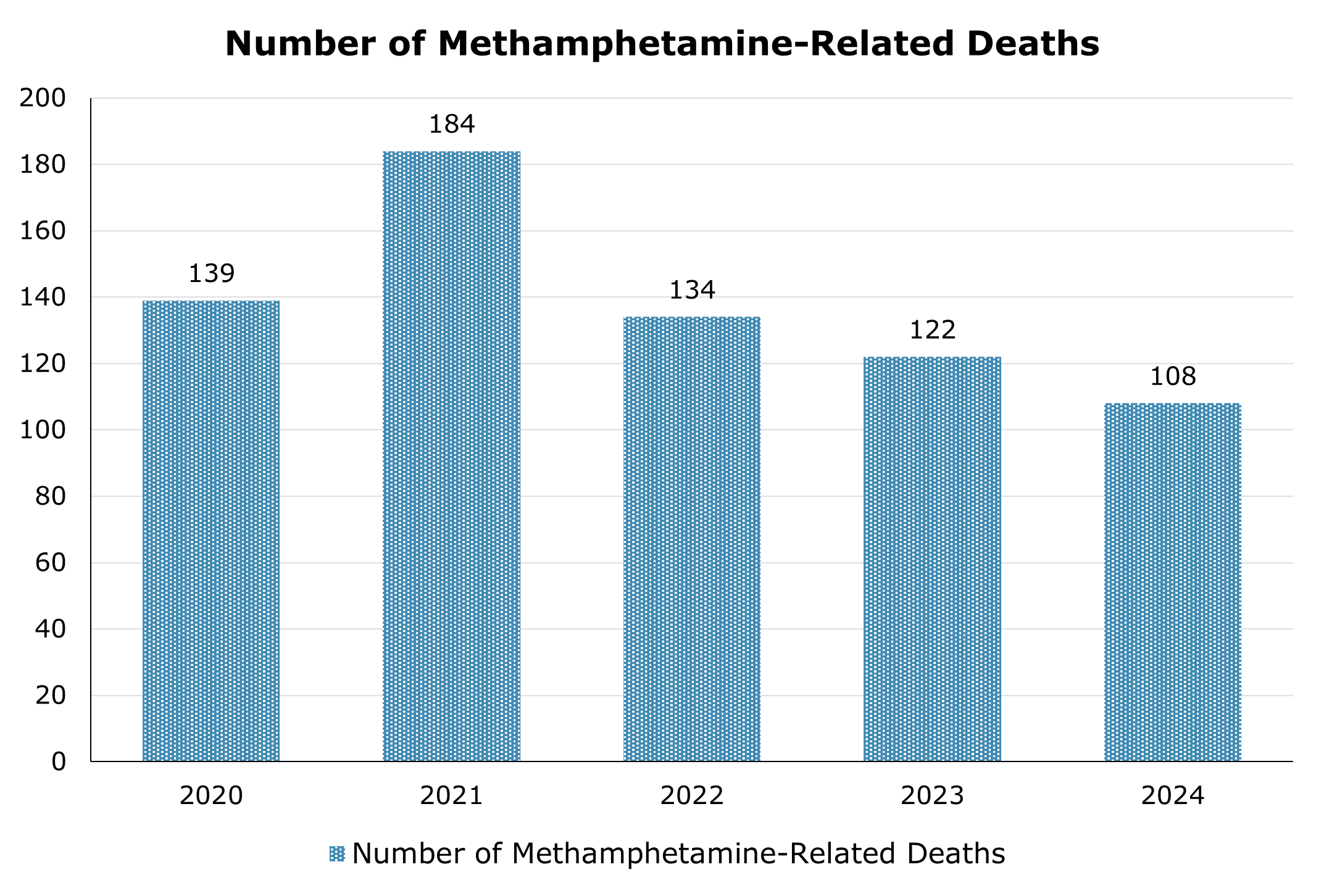
Decedent specimens that test positive for methamphetamine continue to be a significant portion of the drug-related deaths that occur. Figure 22 illustrates the number of drug-related deaths that tested positive for methamphetamine between 2020 and 2024. The data shown indicates that in 2024 there were 108 methamphetamine drug-related deaths recorded, which indicates a sustained decline in the number of methamphetamine-related deaths from the peak of 184 in 2021.
| 2020 | 2021 | 2022 | 2023 | 2024 | |
|---|---|---|---|---|---|
| Number of Methamphetamine-Related Deaths | 139 | 184 | 134 | 122 | 108 |
Drugs and Alcohol in Driving Cases
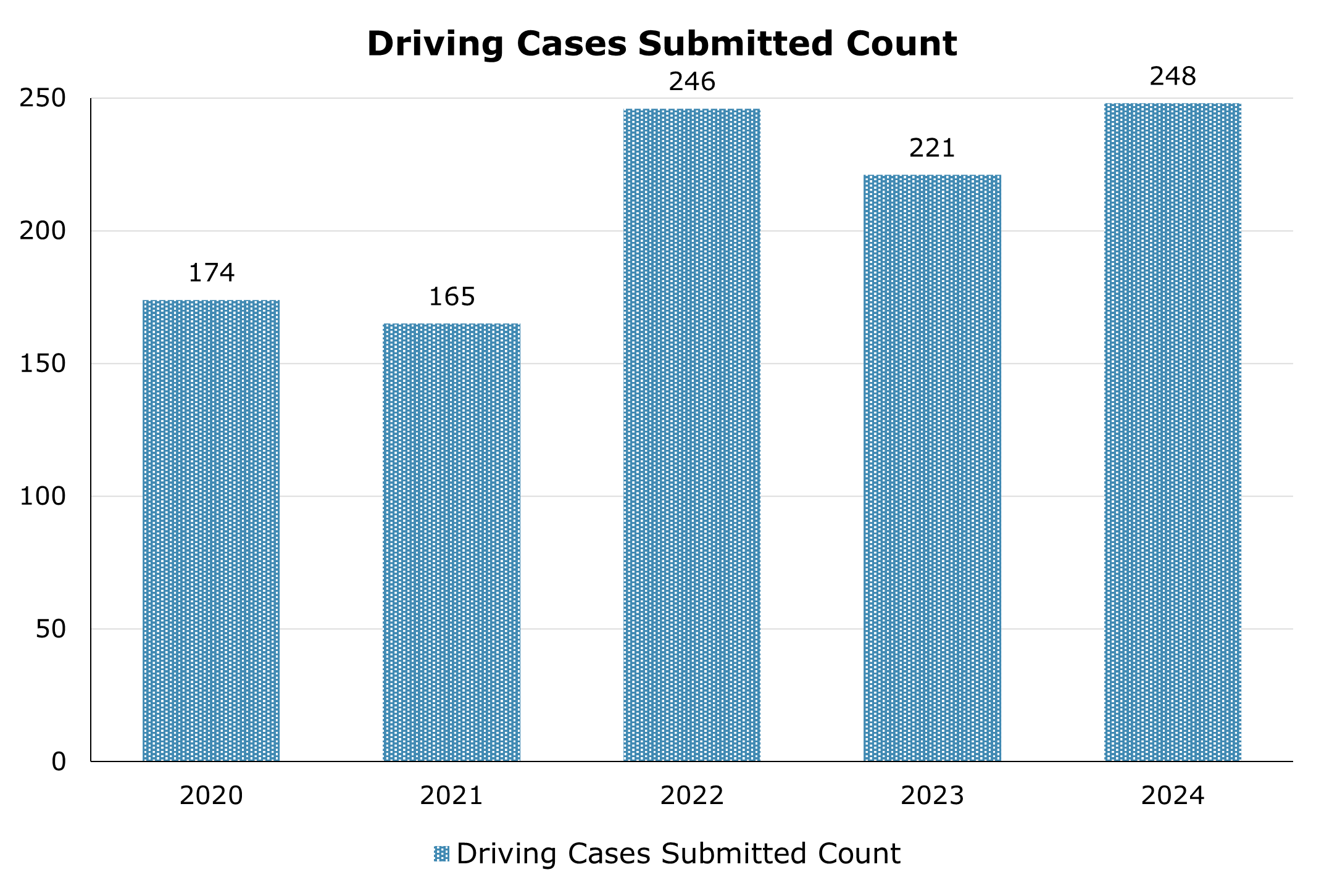
Many impairment investigations involve motorists under the influence of psychoactive drugs and/or ethanol. Analytical results summarized in Figure 23 and Table 8 reflect the toxicological findings from the 224 blood draw kits yielding positive results out of the 248 submitted in 2024. These cases encompass a range of driving-related offenses, including DUI/DUID, controlled-substance violations, vehicular homicide, vehicular fatality, police evasion, and hit-and-run incidents. Across all specimens, laboratory testing identified 47 distinct parent drugs, metabolites, and ethanol, yielding a total of 471 confirmed analytes, indicating substantial polysubstance involvement within the submitted case population.
| 2020 | 2021 | 2022 | 2023 | 2024 | |
|---|---|---|---|---|---|
| Driving Cases Submitted Count | 174 | 165 | 246 | 221 | 248 |
| Drugs Detecting in Antemortem Driving Cases | 2020 | 2021 | 2022 | 2023 | 2024 |
|---|---|---|---|---|---|
|
11-Hydroxy-Delta-9-THC |
0 |
0 |
1 |
0 |
0 |
|
7-Aminoclonazepam |
9 |
6 |
5 |
5 |
2 |
|
9-hydroxyrisperidone |
0 |
0 |
0 |
0 |
1 |
|
a-Hydroxyalprazolam |
0 |
0 |
0 |
6 |
2 |
|
Alprazolam |
18 |
20 |
11 |
14 |
10 |
|
Amphetamine |
43 |
40 |
41 |
45 |
35 |
|
Aripiprazole |
0 |
0 |
0 |
0 |
1 |
|
Benzoylecgonine |
9 |
21 |
13 |
9 |
16 |
|
Bromazolam |
0 |
1 |
1 |
3 |
8 |
|
Butalbital |
1 |
1 |
2 |
0 |
0 |
|
Cannabidiol [CBD] |
0 |
0 |
0 |
3 |
0 |
|
Carboxytetrahydrocannabinol^ |
1 |
0 |
0 |
0 |
1 |
|
Carisoprodol |
0 |
3 |
2 |
1 |
1 |
|
Clonazolam |
3 |
0 |
0 |
0 |
0 |
|
Clonazepam |
10 |
5 |
3 |
5 |
2 |
|
Cocaethylene |
0 |
0 |
1 |
3 |
2 |
|
Cocaine |
0 |
3 |
5 |
5 |
4 |
|
Codeine |
0 |
2 |
1 |
0 |
0 |
|
Delta-8-Carboxy-THC^ |
0 |
0 |
5 |
16 |
19 |
|
Delta-8-THC^ |
0 |
0 |
3 |
11 |
12 |
|
Delta-9-Carboxy-THC^ |
0 |
0 |
16 |
71 |
68 |
|
Delta-9-THC^ |
0 |
0 |
13 |
70 |
60 |
|
Diazepam |
0 |
6 |
0 |
2 |
5 |
|
Difluoroethane |
3 |
1 |
2 |
1 |
1 |
|
Doxylamine |
1 |
0 |
0 |
0 |
0 |
|
EDDP |
0 |
0 |
0 |
4 |
5 |
|
Ephedrine |
0 |
0 |
0 |
0 |
1 |
|
Es/Citalopram |
1 |
0 |
0 |
0 |
2 |
|
Ethanol |
106 |
125 |
69 |
81 |
100 |
|
Etizolam |
3 |
0 |
0 |
0 |
0 |
|
Fentanyl |
17 |
57 |
33 |
30 |
13 |
|
Flualprazolam |
13 |
0 |
0 |
0 |
0 |
|
Flubromazepam |
1 |
0 |
0 |
0 |
0 |
|
Flubromazolam |
3 |
0 |
0 |
0 |
0 |
|
Fluoxetine |
0 |
1 |
0 |
0 |
0 |
|
Gabapentin |
1 |
2 |
0 |
0 |
1 |
|
Hydrocodone |
3 |
5 |
10 |
2 |
1 |
|
Hydromorphone |
0 |
1 |
0 |
2 |
0 |
|
Hydroxybupropion |
0 |
0 |
0 |
0 |
1 |
|
Lamotrigine |
0 |
1 |
0 |
0 |
0 |
|
Lorazepam |
0 |
2 |
4 |
1 |
2 |
|
Meprobamate |
2 |
5 |
2 |
1 |
2 |
|
Methadone |
8 |
13 |
9 |
5 |
6 |
|
Methamphetamine |
52 |
60 |
52 |
50 |
46 |
|
Methylenedioxyamphetamine |
2 |
1 |
0 |
0 |
0 |
|
Methylenedioxymethamphetamine |
1 |
2 |
0 |
0 |
1 |
|
Midazolam |
0 |
0 |
0 |
1 |
1 |
|
Mitragynine |
0 |
0 |
0 |
0 |
2 |
|
Morphine |
8 |
6 |
1 |
1 |
1 |
|
Norbuprenorphine |
1 |
0 |
0 |
0 |
0 |
|
Nordiazepam |
3 |
7 |
0 |
2 |
4 |
|
Nordiphenhydramine |
0 |
0 |
0 |
0 |
1 |
|
Norfentanyl |
14 |
49 |
30 |
28 |
12 |
|
Norfluoxetine |
0 |
1 |
0 |
0 |
0 |
|
O-Desmethyltramadol |
2 |
0 |
0 |
1 |
0 |
|
Oxazepam |
1 |
0 |
0 |
0 |
1 |
|
Oxycodone |
7 |
9 |
2 |
5 |
2 |
|
Oxymorphone |
1 |
0 |
0 |
0 |
0 |
|
Phenazepam |
0 |
0 |
0 |
0 |
1 |
|
Phencyclidine |
5 |
5 |
1 |
2 |
4 |
|
Phenobarbital |
0 |
0 |
1 |
1 |
0 |
|
Sertraline |
1 |
0 |
0 |
0 |
0 |
|
Temazepam |
2 |
1 |
0 |
1 |
1 |
|
Tetrahydrocannabinol (THC) |
81 |
84 |
49 |
0 |
0 |
|
Tramadol |
1 |
0 |
0 |
1 |
0 |
|
Trazodone |
0 |
1 |
0 |
0 |
1 |
|
Venlafaxine |
1 |
0 |
0 |
0 |
0 |
|
Xylazine |
0 |
0 |
0 |
0 |
1 |
|
Zolpidem |
3 |
3 |
5 |
8 |
6 |
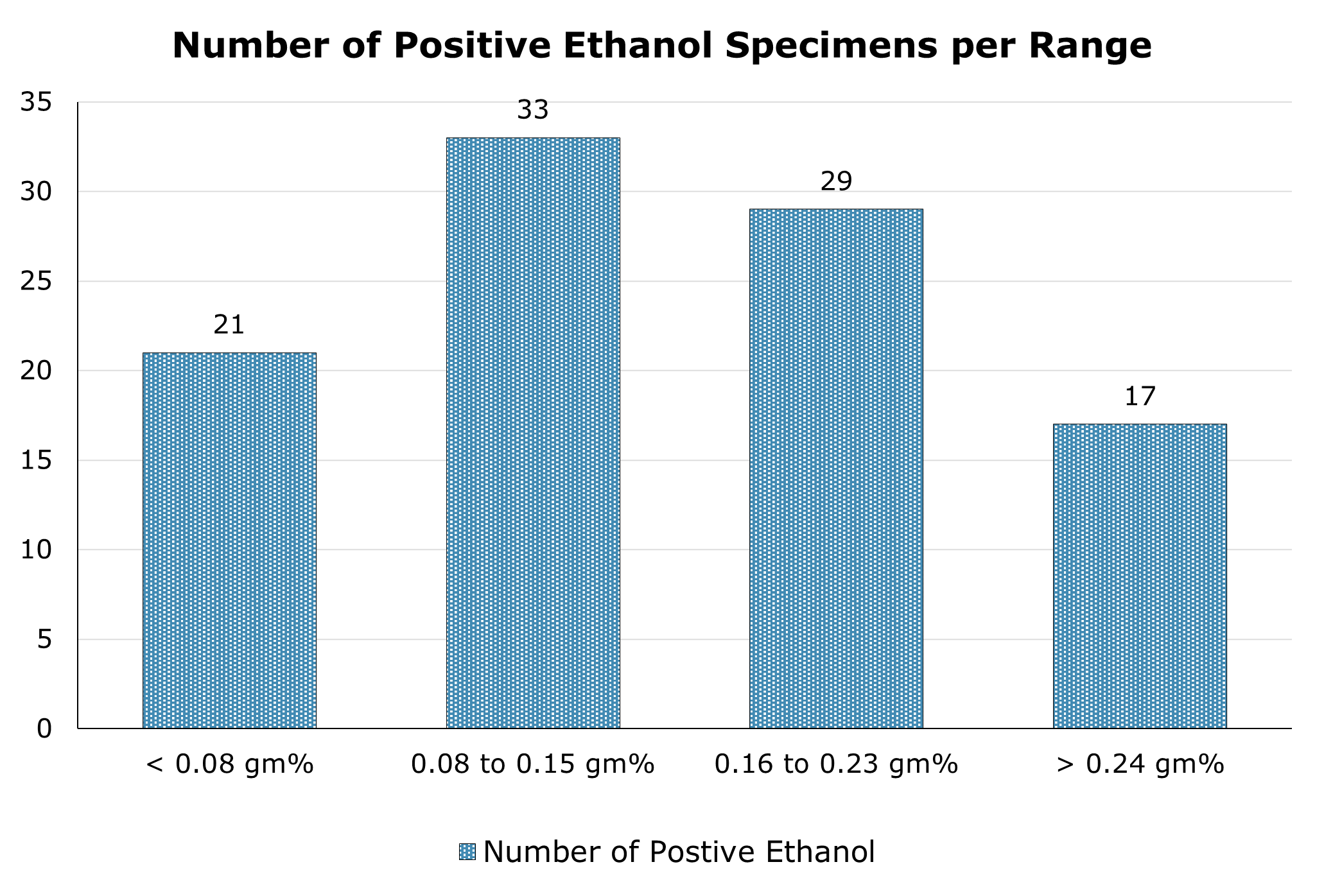
Figure 24 illustrates the distribution of positive ethanol results in postmortem driving cases across four concentration ranges: less than 0.08 gm%, 0.08–0.15 gm%, 0.16–0.23 gm%, and greater than 0.24 gm%. The greatest number of positive findings occurred in the 0.08–0.15 gm% range, with 33 specimens. This was followed by 29 specimens in the 0.16–0.23 gm% range, 21 specimens below 0.08 gm%, and 17 specimens above 0.24 gm%. Overall, the distribution shows that most ethanol-positive specimens were above the legal threshold for impairment. The highest ethanol concentration quantified in a specimen was 0.475 gm%.
| Less than 0.08 gm% | 0.08 to 0.15 gm% | 0.16 to 0.23 gm% | Greater than 0.24 gm% | |
|---|---|---|---|---|
| Number of Positives | 21 | 33 | 29 | 17 |
Drug-Facilitated Sexual Assaults
Drug-facilitated sexual assaults (DFSA) represent a particularly complex category of forensic toxicology casework. Drug-facilitated sexual assault (DFSA) cases represent a particularly complex area of forensic toxicology casework. These investigations may involve either the covert administration of a pharmacologically active substance by a perpetrator or the voluntary ingestion of such a substance by a victim. In either circumstance, the substance may impair the victim through sedation, incapacitation, or anterograde amnesia, thereby facilitating the commission of a sexual assault.
DFSA case specimens frequently contain multiple drugs, drug metabolites, and/or ethanol. In the 2024 submissions, positive results were reported for 6 of the 7 cases submitted. Laboratory analysis identified 17 distinct analytes, which collectively accounted for 23 total positive drug confirmations across all cases, reflecting the polysubstance patterns commonly observed in DFSA toxicology.
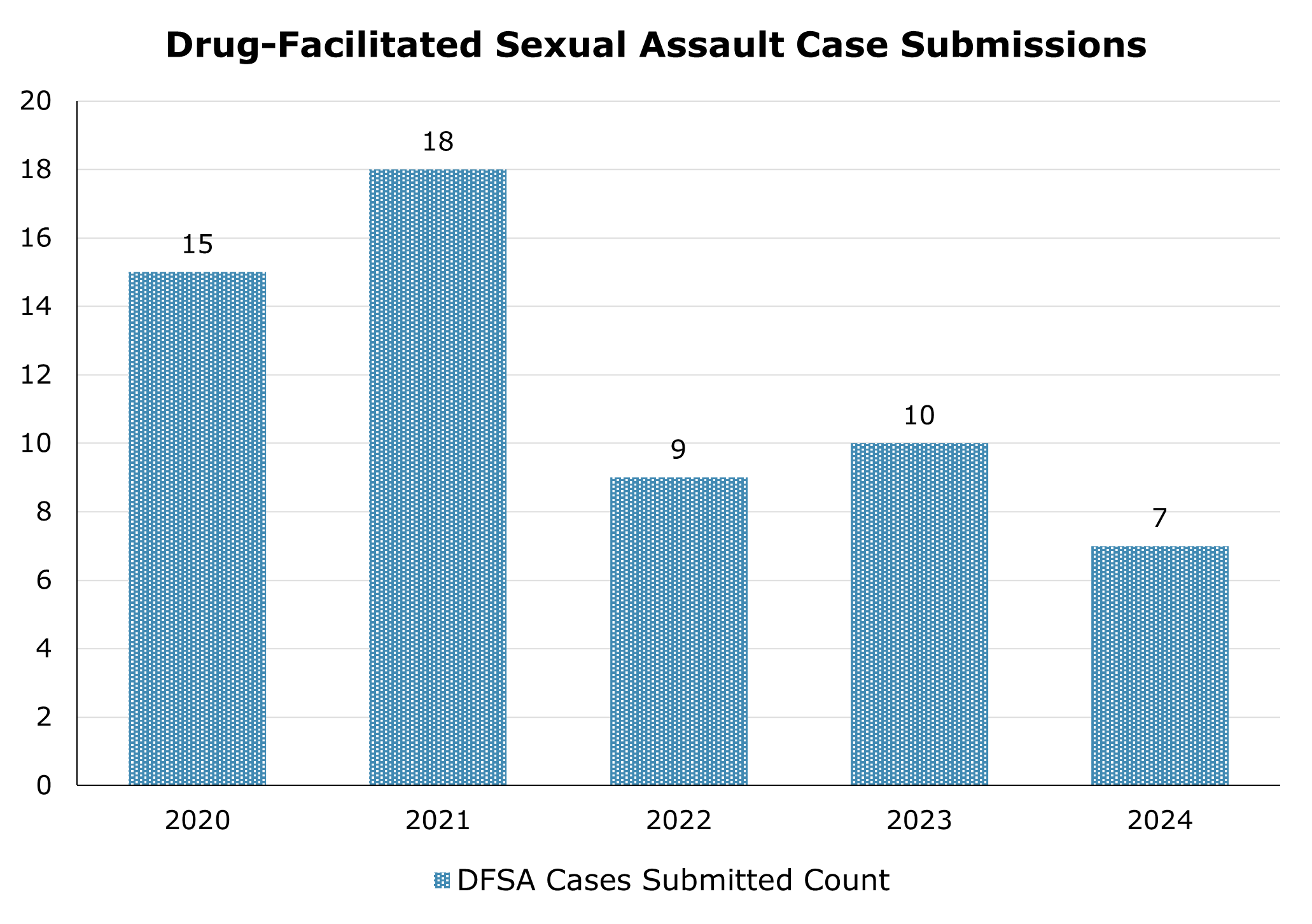
Figure 25 shows that DFSA case submissions increased from 15 in 2020 to 18 in 2021, then declined to 9 in 2022, rose slightly to 10 in 2023, and decreased again to 7 in 2024. Overall, the data indicates that DFSA submissions do not follow a consistent trend and instead fluctuate from year to year.
| 2020 | 2021 | 2022 | 2023 | 2024 | |
|---|---|---|---|---|---|
| DFSA Cases Submitted Count | 15 | 18 | 9 | 10 | 7 |
Expert Testimony
Court testimony is the culmination of forensic science work and scientists are trained to convey complicated technical information and results to juries. The professional staff is frequently called upon to present expert testimony in court. The amount of time spent by staff preparing for testimony, waiting to testify at courthouses, and on the stand providing testimony is significant.
In 2024, the Forensic Science Laboratories received subpoenas for 87 criminal cases and provided expert testimony in 30.